The federal CO₂ calculator: what the building estimate really shows
The new online tool calculates direct emissions from residential buildings under standard conditions. It draws on register data – and replaces neither a utility bill nor a GEAK certificate.
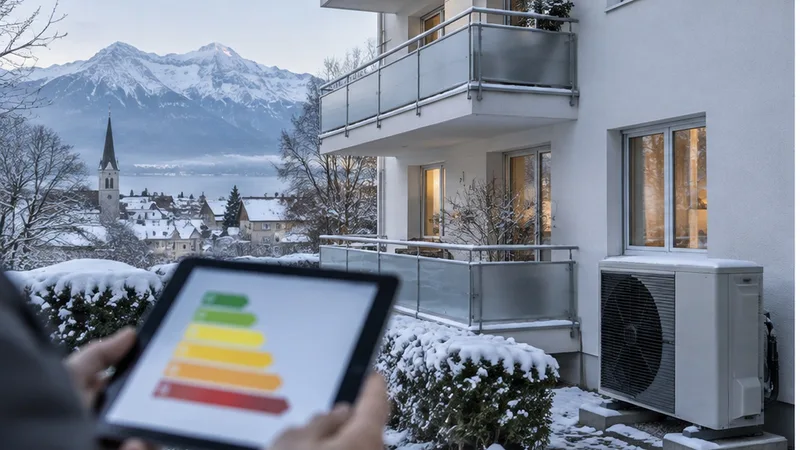
Since May 2026, an estimated CO₂ value can be retrieved for every Swiss residential building. The Confederation's interactive calculator draws on the Federal Building Identifier (EGID) and shows how high direct emissions for heating and hot water could be under standard conditions.
At first glance the tool looks precise. It returns values per square metre of heated floor area and lets users simulate retrofits or a switch of energy source. The federal government itself, however, warns against overinterpretation: the results are rough estimates, not official or binding figures.
What goes into the calculation
The basis is public data from the Federal Register of Buildings and Dwellings (GWR). Among the factors taken into account are use, heated floor area, year of construction, number of storeys, heating system, and altitude and topographical location. The calculation follows SIA standard 380/1.
The calculator therefore models a standardised demand for heating energy and hot water. It does not measure how much oil, gas or electricity the occupants actually consume. Room temperature, occupancy, ventilation behaviour, weather and the technical condition of the heating system can all shift the real balance.
The data base has limits too. The GWR is updated continuously, but according to the federal government it does not hold current heating data everywhere and no complete information on building retrofits. A renovated facade or new windows may therefore be missing. Users may add retrofit details for the simulation; those entries are not stored in the register.
Zero is not emission-free
The system boundary needs particular explanation. Buildings with renewable heating are assigned a value of zero for direct CO₂ emissions in the calculator. The same currently applies to district heating. That does not mean that construction, electricity generation or the heating network cause no emissions.
Like the national greenhouse gas inventory, the calculator looks only at direct emissions at the building itself, so-called Scope 1. Electricity and its generation (Scope 2), as well as embodied emissions from building materials, construction and supply chains (Scope 3), remain outside the boundary. A value of zero therefore describes the chosen accounting boundary, not complete climate neutrality.
This demarcation makes the calculator useful for one specific question: how does a building's direct output change when a fossil heating system is replaced or the building envelope is improved? For a comprehensive climate comparison of different systems, the figure alone is not enough.
No substitute for a bill or a GEAK
Anyone who wants to know how much energy a house actually needs requires consumption data. Anyone who needs an in-depth energy assessment and retrofit plan can have a cantonal Building Energy Certificate (GEAK) drawn up. It examines the individual building in more detail and in some cantons is required for property transfers or subsidy applications.
The online calculator, by contrast, is a low-threshold point of orientation. It can show owners how strongly the energy source and the state of retrofit affect the standardised value. It should not serve as the sole evidence for purchase decisions, tenancy disputes or subsidy commitments.
Building value and national inventory are different things
The linked EGID value is not a new estimate of total Swiss emissions. The BAFU's national greenhouse gas inventory accounts for all sectors according to international rules. The federal government puts the share of the building stock in domestic CO₂ emissions at around 22 percent. The sector is therefore significant for climate policy; under the long-term climate strategy, buildings are to emit no direct CO₂ at all by 2050.
The calculator can create transparency and make outdated register entries visible. Its greatest strength, however, lies precisely not in apparent exactness. It makes assumptions verifiable. Anyone reading the value should therefore always ask three questions: is the building data current, which emissions are included, and is this standardised demand or measured consumption?