Verkehr ’45: Billions in projects prioritised without secured funding
The Federal Audit Office praises cross-modal planning for the first time, but criticises cost-benefit calculations, missing alternatives and a funding gap up to 2045.
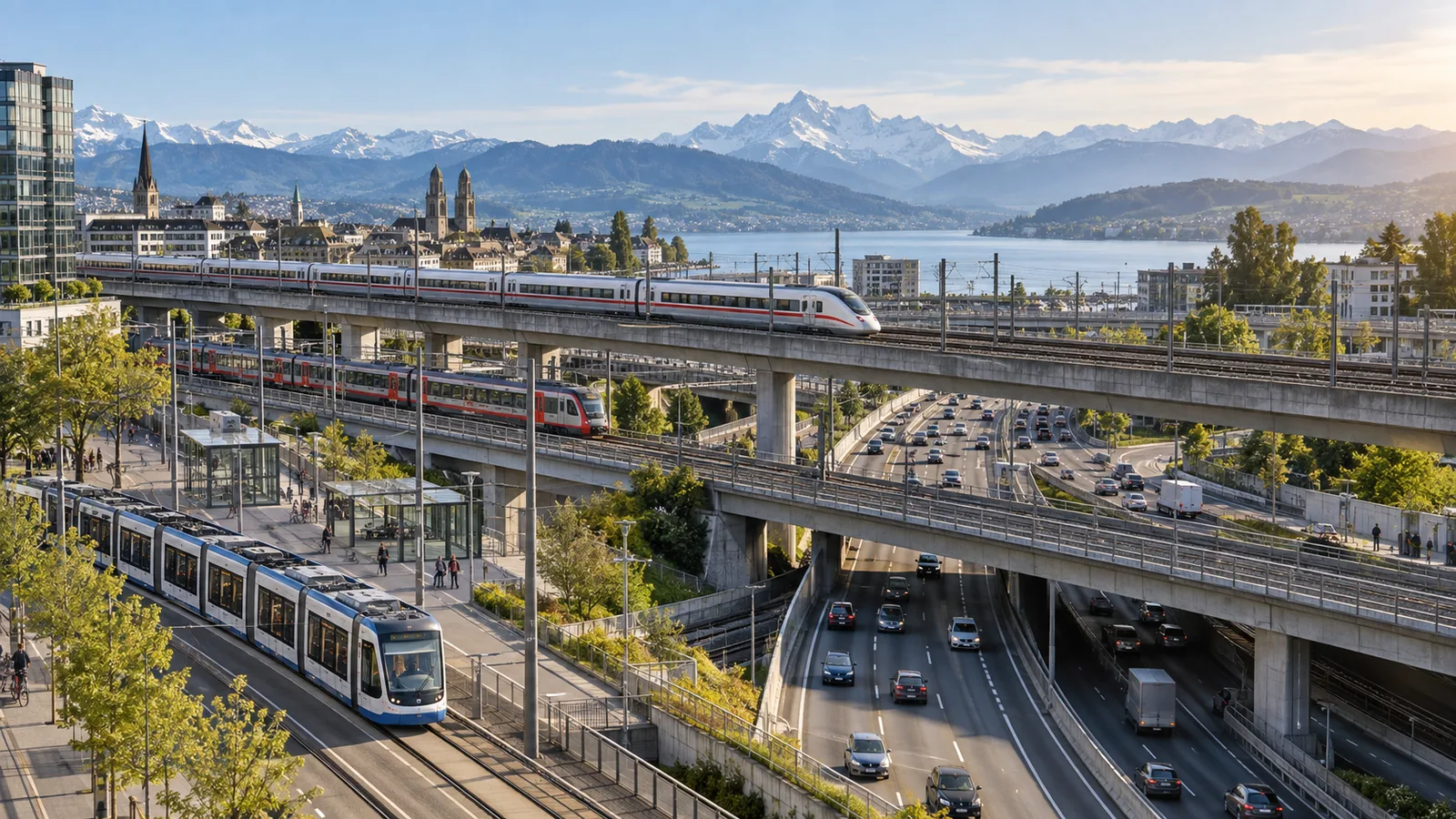
Switzerland does not have too few transport projects; it has too many for the money available. That is the uncomfortable starting point of «Verkehr ’45». The Swiss Federal Audit Office (EFK) puts the projects prioritised by ETH Zurich at 112 billion francs. Around 50 billion of that is planned up to 2045. For the draft scheduled for early 2027, the EFK cites a project volume of 11 billion; that figure describes the state of affairs it examined. For the programme as a whole, it says, the financing is not demonstrated.
The criticism targets a project that fundamentally represents progress. For the first time, the Confederation wants to consider rail, national road and agglomeration transport expansions together. The aim is to make competition and interactions between transport modes visible. The Federal Audit Office praises this approach – but considers the basis for several new projects too weak to derive a robust ranking from it yet.
A prioritisation with a limited audit mandate
The Federal Department of the Environment, Transport, Energy and Communications (UVEK) commissioned ETH Zurich to assess projects up to 2045. According to the EFK, however, the scope of the expert opinion was heavily restricted. Cost-benefit calculations were partly based on assumptions that could make costs and benefits appear more favourable. In addition, alternatives to individual motorway expansions had not been systematically re-examined.
The EFK cites dynamic speed limits and the conversion of hard shoulders as examples of measures that can reduce bottlenecks efficiently. That does not mean they can replace every expansion. It means a billion-franc project can only count as the best solution once cheaper operational variants have been assessed using the same criteria.

Three figures, three different levels
The amounts of 112, 50 and 11 billion are not interchangeable. The 112 billion covers the projects prioritised by ETH over a broad horizon. Around 50 billion relates to projects that, according to the EFK, are planned up to 2045. At the time of the audit, the projects representing these 11 billion francs were intended to be submitted to Parliament in early 2027.
The current UVEK consultation, by contrast, cites around 20 billion francs for the rail expansion in 2027 and 1.6 billion for two new national road projects. These package totals must not be equated with the selection of new projects in the EFK audit report. The UVEK also handles maintenance and agglomeration contributions in separate federal decrees and timeframes. Anyone who adds up individual amounts without taking that scope into account produces false precision. That is precisely why Parliament needs a consolidated calculation for each package: investment, operation, follow-up costs, funding source and sensitivity to higher construction prices.
Rail needs additional revenue
For the rail expansion, the consultation assumes additional revenue. The Federal Council points in particular to extending the value-added tax per-mille earmarked for the Rail Infrastructure Fund, which is currently limited to 2030. At the same time, costs are to be stabilised and digital capacity gains exploited. Whether these measures will actually be decided politically is open.
For national roads and agglomeration transport, the Confederation points to the existing framework of the National Roads and Agglomeration Transport Fund. The financial planning there also assumes a levy on electric vehicles from 2030. That is a financing assumption, not revenue already available. A fund is not an unlimited source of money. New investments compete with operation, maintenance and projects already decided.
What the criticism means for the regions
Every postponement has winners and losers. Cantons and cities plan settlements, junctions and their own investments around expected federal projects. If a project is scrapped later, political and planning costs arise. If it is built despite weak cost-effectiveness, money is missing elsewhere.
The consultation runs until 9 October 2026; the dispatch is scheduled for February 2027. That timetable allows for a correction. The EFK, however, called for the project to be suspended until key points were clarified. The Federal Council did not follow that call.
The central decision is therefore not rail versus road. It is: which projects demonstrably solve the biggest problems per franc spent – and which financing will the public and Parliament actually support? As long as that calculation is not on the table for every package, «Verkehr ’45» is a list of priorities, but not yet a robust investment plan.
No construction decision has been taken yet
The ongoing consultation is not a formal side step. Cantons, parties, associations and other interested parties can submit their positions until 9 October; after that the Federal Council must revise the draft and put it to Parliament. Separate referendums are planned for the federal decrees on rail and national roads. Today’s project list is therefore politically weighted, but not yet final. All the more important, then, that financing and alternatives become traceable before the dispatch.


