Voting day 2026: what the double No means
Both initiatives fail in every canton. The result protects political room for manoeuvre – without ending the debates.
Voting day 2026 ends with two clear Nos. Switzerland said No twice on 27 September. Both the neutrality initiative and the food initiative fail on the popular vote and on the majority of cantons. What is remarkable is not only the scale of the rejection but also its geographic uniformity: neither proposal wins a majority in a single canton.
The provisional official final results thus show a clear pattern. Voters do not fundamentally question either neutrality or food security. But they reject two constitutional models that would have sharply narrowed political room for manoeuvre and would have enshrined ambitious goals as binding.
The results at a glance
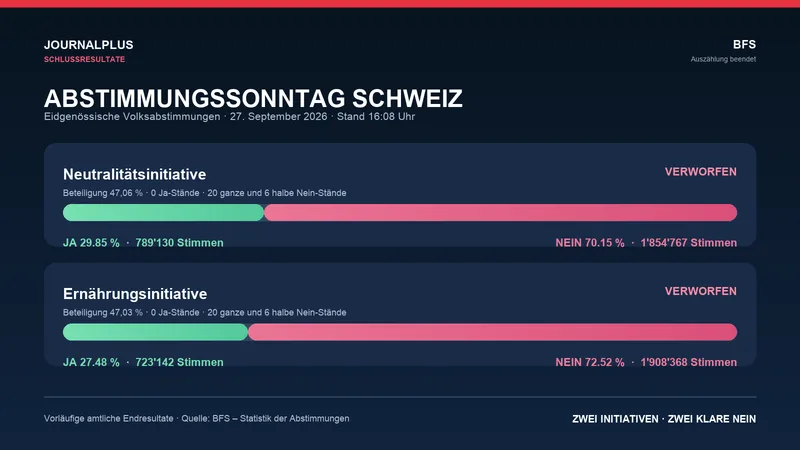
The neutrality initiative wins 29.85 percent Yes and 70.15 percent No. 789,130 people vote in favour, 1,854,767 reject the proposal. Turnout is 47.06 percent.
For the food initiative, the No is even clearer: 27.48 percent Yes against 72.52 percent No. That corresponds to 723,142 Yes votes and 1,908,368 No votes. Turnout stands at 47.03 percent.
Both initiatives are rejected by all cantons. Because they were constitutional amendments, both a majority of the people and a majority of the cantons would have been required. Both hurdles are clearly missed.
Neutrality: a No to enshrining it, not to neutrality
The neutrality initiative sought to anchor permanent and armed neutrality explicitly in the Federal Constitution. It also demanded that cooperation with military and defence alliances be sharply limited. Sanctions against states at war would in principle have been ruled out unless they were decided by the UN Security Council or served to prevent circumvention transactions.
With the No, the current order remains in place. Switzerland stays neutral, but the Federal Council and Parliament keep their room for manoeuvre in shaping neutrality policy in practice. They can continue to decide case by case on sanctions, security-policy cooperation and cooperation with international partners.
The result should therefore not be read as a mandate to take on sanctions as often as possible or to move closer militarily. It is rather a decision against a rigid constitutional rule that would have bound future governments regardless of the security situation at the time.
Politically, the verdict strengthens the Federal Council and the parliamentary majority. Both had warned of a loss of foreign- and security-policy flexibility. For the initiative committee around Pro Schweiz and exponents of the SVP, the nationwide rejection is, by contrast, a clear defeat. The debate about the credibility of neutrality is likely to continue nonetheless – especially in the face of new wars, sanctions or questions of the European security order.
Food: support for the goals, doubts about the instrument
The food initiative combined supply security, environmental policy and consumer behaviour. It sought a net self-sufficiency rate of at least 70 percent, a stronger shift of production towards plant-based foods and more binding environmental targets for water, soil and biodiversity. The goals were to be reached within ten years.
The Federal Council and Parliament criticised above all the combination of a high target, a short deadline and far-reaching interventions. In their assessment, the state would have had to steer production, trade and consumption more heavily. Parliament recommended rejection without a counter-proposal.
The clear No does not remove the underlying problems. Switzerland remains dependent on imports for animal feed, fertiliser, energy and numerous foodstuffs. At the same time, agriculture and politics are under pressure to protect drinking water, soil and biodiversity better.
What was rejected was thus less the goal of crisis-proof supply than the proposed route to it. There will be no new 70 percent requirement in the constitution, nor a binding ten-year plan for more plant-based production. Improvements must now come through existing agricultural, environmental and trade policy.
What the double No has in common
Both proposals addressed real uncertainties. The neutrality initiative responded to a harsher international security environment and the controversy over sanctions. The food initiative put the crisis resilience of supply and ecological limits at the centre.
The majority did not, however, accept these problem descriptions as a justification for sweeping constitutional mandates. That is the most important shared message of the voting day: voters want to preserve room for manoeuvre and prefer step-by-step political solutions to rigid requirements.
The moderate turnout of around 47 percent also belongs in the picture. It is in the range of many federal votes. The result is clear enough that neither narrow majorities nor individual regions were decisive.
The cantonal decisions
Alongside the two federal initiatives, twenty cantonal substantive proposals went to the vote. Nine were accepted and eleven rejected. Three tie-break questions were also on the ballot.
- Zürich rejects the amendment to the teaching staff law (40.76 percent Yes) and accepts the proposal on self-determination at the end of life in hospitals and care homes (68.11 percent).
- Bern rejects the education initiative (40.07 percent Yes).
- Lucerne accepts the fan violence initiative (52.82 percent) and the counter-proposal (74.76 percent). In the tie-break question, the counter-proposal prevails with 58.84 percent. Also accepted are longer opening hours for unstaffed shops (55.18 percent), location promotion (65.06 percent) and the expansion of the Reussbühl cantonal school (67.62 percent).
- Basel-Stadt rejects the anti-hooligan initiative (35.68 percent Yes) and the planned collection centre (13.15 percent).
- Basel-Landschaft rejects both the land value gain levy initiative (31.75 percent Yes) and the counter-proposal (43.87 percent). The tie-break question is therefore moot.
- Schaffhausen rejects the traffic flow initiative (46.74 percent Yes) and the counter-proposal (46.31 percent). Here too the tie-break question is moot.
- Graubünden says No to a voting age of 16 (32.58 percent Yes).
- Vaud accepts the tax cut initiative for the middle class (53.14 percent).
- Geneva approves free contraception (58.46 percent) and a loan for cross-border projects (56.78 percent). Rejected are the facilitated home purchase for tenants (36.48 percent Yes) and HES-SO funding (41.48 percent).
The cantonal results show a more differentiated picture than the national votes. Clearly defined projects and reforms were able to win majorities. Sweeping packages or institutionally contested changes had a harder time.
Winners, losers and open questions
Among the political winners are the Federal Council and Parliament. Their argument that both initiatives went too far and restricted the state's room for manoeuvre found broad support. Also strengthened are those forces that want to develop neutrality and agricultural policy further through legislation and concrete individual measures.
The initiative committees, by contrast, suffer clear defeats. Yet they have set themes that will not disappear: how far may Switzerland go with sanctions? How closely should it cooperate on security policy? How can supply be secured in crises without over-regulating consumption and production? And how will agriculture's environmental targets be met?
The answers will not be prescribed by new constitutional articles. They must be negotiated in Parliament, in ordinances and in future reforms.
What concretely follows now
Legally, nothing changes at federal level. The two proposed constitutional amendments do not enter into force. The Federal Council keeps its existing competence to adapt neutrality policy to circumstances within the framework of international and constitutional law. On food, the existing constitutional provisions and laws continue to apply.
Politically, the outcome is likely to be read as a mandate for pragmatic, clearly limited solutions. Anyone wanting to push reforms after this voting day will have to explain more precisely which instruments are needed, what costs arise and where the limits of state intervention lie.
Conclusion
27 September 2026 ends with a double No that was uniform across the country. Switzerland holds to neutrality and to the goal of secure food supply, but forgoes rigid constitutional recipes.
The result protects political room for manoeuvre – and thereby also transfers responsibility. The Federal Council and Parliament cannot rest content with filing the two initiatives away as done. The security situation, dependence on imports and ecological pressures remain. After the clear No, the harder phase therefore begins: developing concrete solutions that can command majorities.
Further information
The chronological development of the day is documented in the JournalPlus live ticker. The detailed official federal results can be retrieved in the voting dashboard.