Wind Power in Switzerland: Site Disputes Enter Next Round
The Federal Government is revising its wind energy concept. More areas could become eligible for wind turbines. However, significant conflict persists between power supply, landscape protection, and municipal interests.
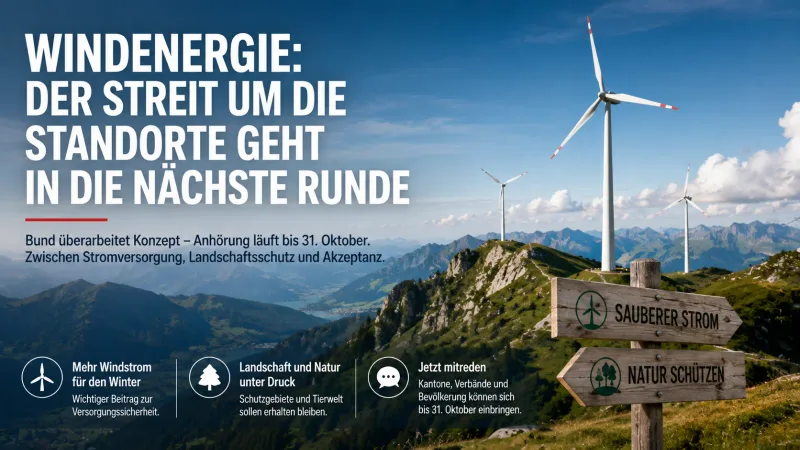
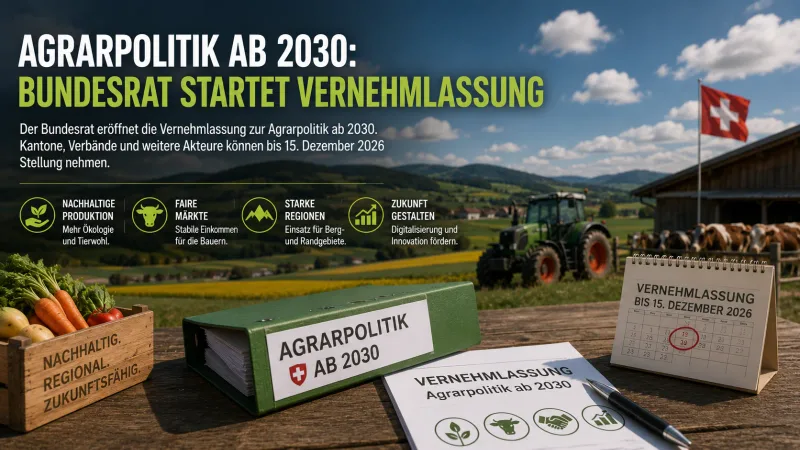
Bern – Where wind turbines may be built in Switzerland could change significantly in the coming years. The Federal Government has launched the consultation on the revised Wind Energy Concept. Cantons, municipalities, political parties, associations, and the public can now submit their opinions.
This is not about individual wind turbines or concrete building applications yet. The focus is on a much more fundamental question: Which areas should generally be considered for wind energy use – and which should remain protected?
The topic is politically sensitive. Switzerland needs additional renewable electricity, especially in winter. At the same time, wind power plants are often debated in areas where landscapes, forests, animals, and the local population are particularly sensitive.
Why the Federal Government is Revising the Concept Now
The previous Wind Energy Concept was adopted by the Federal Council in 2020. Since then, the legal framework has changed.
A decisive step was the popular vote in June 2024. At that time, the Swiss population approved the Federal Act on a Secure Electricity Supply with Renewable Energies with 68.7 percent "Yes" votes. The law strengthens the expansion of renewable energies and creates simplified planning conditions for certain installations of national interest.
In addition, new or adapted rules apply to the planning and approval of large energy installations. Accelerated procedures have been in effect since April 2026 for large solar, hydro, and wind power plants of national interest.
The Federal Government must therefore adapt its planning principles to the new legal situation.
More Than Just a Few New Wind Turbines
The Wind Energy Concept is not a construction program. Instead, it outlines how various interests should be considered during planning.
These include energy supply, nature and landscape protection, noise protection, civil aviation, and national defence.
Wind farms producing at least 20 gigawatt-hours per year are generally considered of national interest. For such projects, the interest in electricity production can therefore carry more weight than before.
This is precisely where the political explosiveness lies: The more crucial wind energy is deemed for electricity supply, the harder it becomes to prevent it solely by citing landscape or local interests.
Why Wind Power is Particularly Interesting in Winter
Wind energy offers a particular advantage for Switzerland: it produces a large proportion of its electricity during the winter half-year.
This is important because electricity demand rises in winter, while photovoltaic systems generate less energy. Hydropower also produces differently seasonally compared to summer.
The Federal Office of Energy therefore considers wind energy a complement to hydro and solar energy.
For Switzerland, this is not only about climate protection. It is also about the question of how the country can organize its electricity supply in winter as securely and independently from abroad as possible.
But That is Precisely Where the Conflict Begins
Wind turbines require space. And they are often located in exposed areas – on ridges, in mountain regions, or other areas with good wind conditions.
This pre-programs conflict: the best wind sites can simultaneously be valuable landscapes or ecologically sensitive.
Construction also involves more than just the turbine itself. It requires access roads, construction sites, foundations, and a connection to the electricity grid.
For nature conservation organizations, it is therefore crucial where wind power plants are built and how early potential conflicts are identified.
Environmental Associations Do Not Say a General No
The position of environmental organizations is more nuanced than the often heated political debate suggests.
The environmental alliance, including organizations like BirdLife Switzerland and Pro Natura, generally advocates for renewable energies and nature-compatible expansion. At the same time, it demands careful planning of suitable areas and early clarification regarding the protection of species and habitats.
Pro Natura, for example, considers the expansion of wind energy possible but demands that protected areas and particularly sensitive habitats be excluded. The impact on birds and bats should also be considered during site selection.
The dispute therefore revolves less around the question "wind power yes or no," but increasingly around the question: Where is wind power acceptable – and where is it not?
The Industry Wants More Speed
Naturally, the wind energy industry views the development differently. Suisse Eole welcomes the expansion and particularly emphasizes the importance of wind energy for winter supply security.
From the industry's perspective, one of the biggest problems remains the long duration of planning and approval procedures. Even if a site is fundamentally suitable, it can take years before a project can actually be built.
The Federal Government has already reacted to this: With the acceleration decree in effect since April 2026, procedures for large energy installations of national interest have been streamlined.
This makes the next question even more important: Is the new acceleration sufficient – or do the planning principles also need fundamental adjustment?
What Does This Mean for the Swiss Public?
At first glance, the debate seems far removed from everyday life. However, the site question directly impacts Switzerland's electricity supply.
First: supply security. More domestic wind power could help reduce reliance on electricity imports in winter. Especially in strained European electricity markets, additional domestic production can be valuable.
Second: the landscape. Anyone living in a region with planned wind farms must expect changes to the landscape. Wind power plants are large structures and can be visible from afar.
Third: the municipalities. For the local population, it is not just about energy policy, but about the concrete question of what should be built on their doorstep. Municipal co-determination therefore remains a central political point of contention.
Fourth: electricity prices. More wind energy does not automatically mean cheaper electricity for households. Costs depend on the entire energy system – from production and grids to storage and imports. However, additional domestic production can help make the system more robust in winter.
Cantons Ultimately Decide on Specific Areas
The new concept does not mean that the Federal Government will have a wind turbine erected somewhere tomorrow.
The specific designation of suitable areas occurs via cantonal structural planning. The Federal concept serves as an important basis, indicating which federal interests must be considered.
Only then do concrete projects involve land-use planning, permits, and the detailed examination of nature, landscape, and other interests.
For the public, this means: Today's consultation does not yet decide where a wind turbine will stand tomorrow. However, it influences the rules by which such decisions will be made in the future.
The Public Can Participate Until End of October
The consultation and public participation period runs until October 31, 2026. Submissions can be made by affected parties and also by the general public.
After that, the Federal Government will evaluate the feedback and revise the concept. The goal is greater planning certainty for authorities and project developers.
This is important for the energy industry because wind projects are long-term investments. For nature conservation, it is equally important because errors in site selection can be difficult to correct later.
The Real Dispute is Only Just Beginning
With its "Yes" vote on the Electricity Act, Switzerland has fundamentally decided in favor of a stronger expansion of renewable energies. At the same time, the protection of nature and landscape remains a political mandate.
These two goals visibly clash particularly regarding wind power.
The Federal Government therefore seeks to create more clarity with the new concept: Where should wind energy generally be possible? Which areas are excluded? Where is a balancing of interests required?
Whether this succeeds will not be decided solely in Bern. The crucial discussions will later take place in the cantons and municipalities – where the wind turbines would actually be visible.
Therefore, the big question is no longer just whether Switzerland wants to expand wind energy. It is: Where is it willing to change the landscape for it – and where does it draw a line?
Sources
- Federal Office for Spatial Development (ARE): Wind Energy Concept and Consultation 2026
- Federal Office of Energy (BFE): Information on Wind Energy in Switzerland
- Federal Council: Accelerated Procedures for Large Solar, Hydro, and Wind Energy Installations
- Federal Government: Federal Act on a Secure Electricity Supply with Renewable Energies
- Pro Natura / Environmental Alliance: Position on Nature-Compatible Expansion of Wind Energy
- Suisse Eole: Position and Information on Swiss Wind Energy