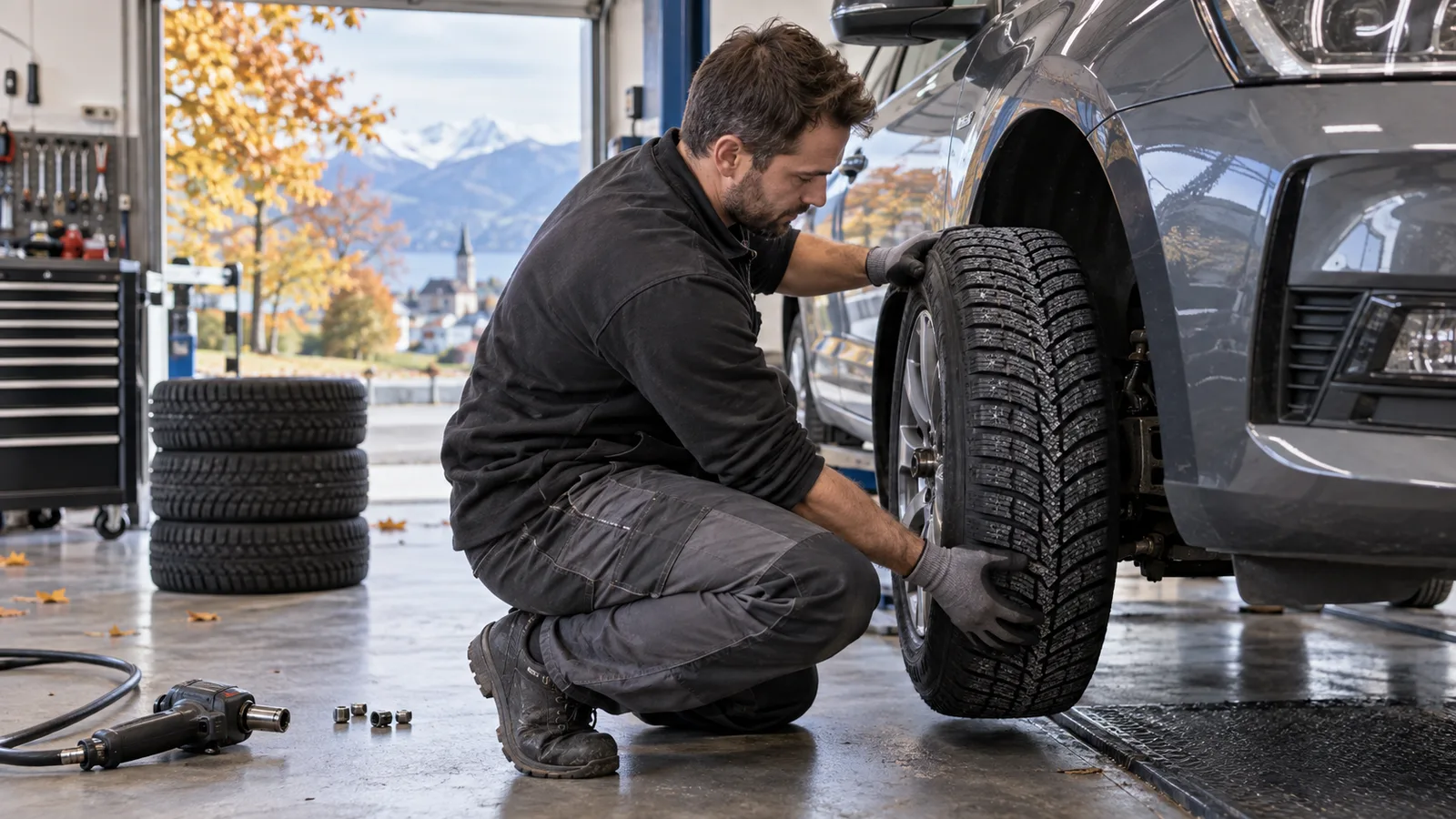
Winter tyres in late September: no Swiss mandate, but clear risks
There is no fixed fitting date. What matters is the route, the temperature, the tread depth and whether the car can be kept safely under control in wintry conditions.
At the end of September, garage appointment books fill up. Even so, Swiss law does not require winter tyres to be fitted by 1 October. It knows neither a general winter tyre obligation nor a fixed date. But anyone who concludes from this that summer tyres are unproblematic in winter overlooks the decisive point: a vehicle must be able to be kept safely under control at all times.
O to O is a rule of thumb
The Swiss Council for Accident Prevention (BFU) recommends winter tyres from October to Easter. This «O-to-O rule» is a practical reminder, not a legal norm. In Switzerland, mountain passes can already see snow in September, while mild days are still possible in the lowlands in November. What counts, therefore, are the times and the routes a driver habitually uses.
Anyone who drives early in the morning, regularly has to head for higher altitudes or depends on the car for work and caring duties should plan the changeover earlier than someone who can switch to public transport when it snows. Booking before the first onset of winter also avoids long waits at the garage.
1.6 millimetres is legal, four are recommended
By law, tyres must have at least 1.6 millimetres of tread. For winter tyres, however, ASTRA and the BFU recommend at least four millimetres. The difference matters in practice: snow and slush have to be displaced from the tread grooves. A tyre that is still legally permissible may therefore already have lost much of its winter capability.
Age counts as well. Rubber hardens over time, even when there is still enough tread. Visible cracks, bulges, uneven wear or repeated pressure loss should be checked by a professional. The correct tyre pressure depends on the vehicle and is usually listed on the door frame, the fuel filler flap or in the owner's manual.
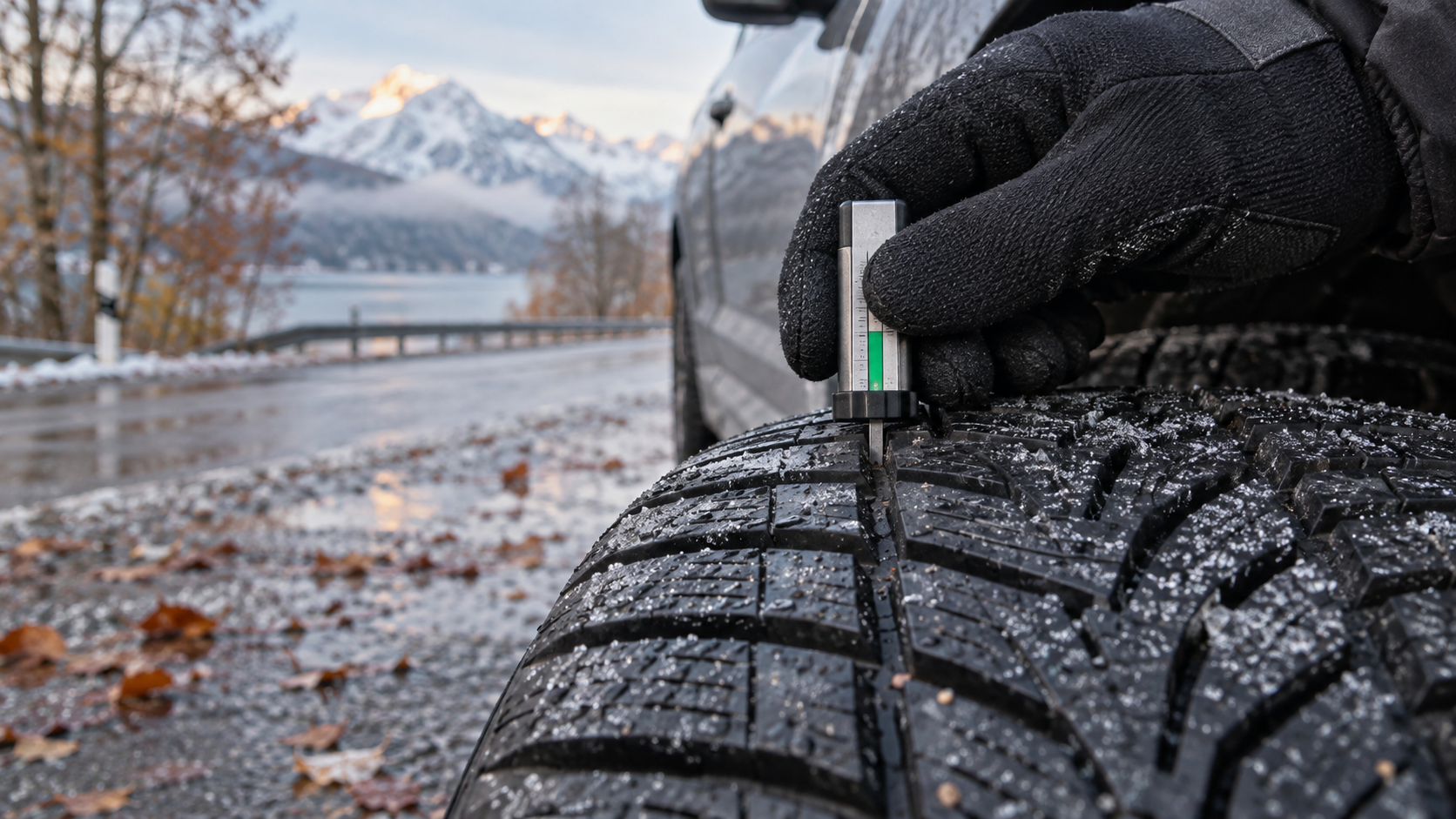
By law, 1.6 millimetres of tread is enough; specialist bodies recommend at least four millimetres for winter tyres. Image: JournalPlus / AI-generated illustrative image.
No obligation does not mean no liability
Road traffic law requires that a vehicle is roadworthy and that the way it is driven matches the conditions. If a car with summer tyres gets stuck on a snow-covered road and blocks traffic, a fine can follow. If an accident occurs, unsuitable tyres can play a role in assessing fault and insurance benefits. Depending on the case, reductions or clawbacks are possible.
This does not mean that every winter accident involving summer tyres is automatically blamed entirely on the driver. Police, insurers and courts examine the cause and the contribution of the tyres in the specific case. But anyone who sets off with worn summer tyres when snow has been forecast creates an avoidable risk.
All-season tyres are a compromise
Modern all-season tyres can be suitable for low annual mileage and predominantly mild lowland conditions. They remain a compromise between summer and winter performance. What matters are the tested properties of the specific model, the snowflake symbol and the driver's own usage profile. For frequent trips into the mountains, heavy vehicles or high motorway mileage, separate sets are often the more robust solution.
For a trip abroad, Swiss law is not enough. Germany, Austria, Italy and France have their own rules, some of which depend on the situation or the region. Snow chains may also be signposted or required. The rules along the route should be checked with the responsible authorities before departure.
The five-minute check
Before the appointment, a short walk around the car is worthwhile: measure the tread depth at several points, check the sidewalls for damage, check the tyre pressure and make sure the wheel wrench, puncture kit or spare wheel are complete. After the changeover, tyre pressure monitoring systems must be reinitialised depending on the vehicle.
So the right moment is not a matter of calendar dogma. It follows from the weather, altitude, driving times and alternatives. Anyone planning at the end of September is not acting too early – they are creating room to manoeuvre before the first snow sends everyone to the workshop at once.
Fitting alone is not enough
Before the changeover, drivers should check tread depth, age, sidewalls and even wear. Tyre pressure should be adjusted to the manufacturer's specification after fitting; incorrect pressure worsens handling and fuel consumption. Storage matters too: cool, dry and protected from the sun. Anyone driving to neighbouring countries must observe their rules. Germany, for example, ties its winter tyre requirement to wintry road conditions, and tyres with the alpine symbol are generally permitted. The Swiss legal situation does not end at the border.


