Zurich seeks headscarf ban in schools – the difficult part now begins
The Zurich Cantonal Council approved an SVP motion by 87 votes to 82. The Executive Council must now draft a legal proposal. Whether and how such a ban is compatible with religious freedom will likely become the central issue.
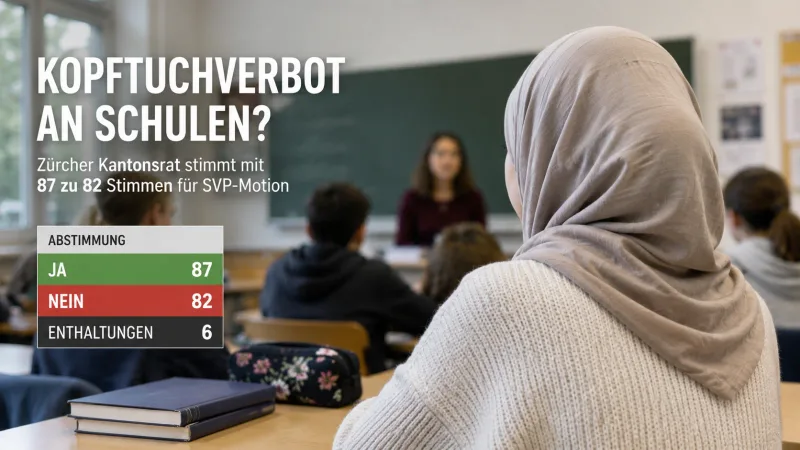
The decision was close on Monday: 87 cantonal councillors voted for the motion, 82 against it, and six abstained. The initiative was primarily supported by the SVP and FDP, along with parts of the GLP and EVP. The SP, Greens, and Mitte opposed it. The Executive Council must now draft a corresponding legal basis. It has two years to do so.
The Headscarf Is Not Yet Banned
Politically, the decision is clear, but legally, it is just the beginning. A motion obliges the Executive Council to present a concrete proposal. Afterwards, the Cantonal Parliament must decide on the draft law.
The Executive Council had already indicated before the vote that it was prepared to accept the motion. Education Director Silvia Steiner stated that the government was willing to draft a constitutionally compliant proposal.
A crucial question is thus already established: A potential ban must not simply be politically desired. It must also be compatible with fundamental rights.
SVP Argues for Equality
The SVP justifies its initiative not solely with religious neutrality. The focus is on the equality of girls and women. The party argues that headscarves are often not worn voluntarily and can express societal discrimination against women.
From the supporters' perspective, school should be a place where girls and boys have the same freedoms and opportunities. According to the SVP, a teacher wearing a headscarf cannot credibly convey these values. The motion also refers to France, where conspicuous religious symbols have been banned in public schools since 2004.
However, the French development does not automatically prove that a headscarf ban leads to better educational outcomes or more successful integration. Such statements must be considered scientifically, separate from the political argument of the motion.
Religious Freedom Versus State Neutrality
Opponents of the initiative focus on a different point: religious freedom. A headscarf can be a religious confession for a Muslim woman. A state ban thus interferes with an area protected by fundamental rights.
The situation for female students is particularly delicate. They are not part of the state themselves but are subject to its protection. A headscarf ban for a female student is therefore legally different from a restriction for a female teacher who teaches on behalf of a public school.
This very distinction could be crucial for the Zurich proposal. However, the initiative explicitly demands a ban for girls and women – meaning for both female students and teachers.
The Crucial Question: Voluntary or Coerced?
Behind the political debate lies a difficult problem. A headscarf can be worn under family or social pressure. However, it can also be an expression of personal religious conviction.
A general ban treats both situations equally. This is precisely what opponents criticize. The Association of Islamic Organizations in Zurich (VIOZ) emphasizes that women and girls must be protected from coercion. At the same time, a distinction must be made between coercion and a self-determined religious way of life.
This question cannot be answered solely based on the garment. For schools, the question is rather how to deal with specific pressure on children – and whether a general ban is indeed the appropriate means for this.
Why the Legal Process Could Be Decisive
The Zurich government thus faces a difficult task. It must formulate a regulation that politically meets the demands of the motion while respecting constitutional limits.
In previous cases, the Federal Supreme Court has already made it clear that a general headscarf ban for female students is not easily compatible with religious freedom. Decisive factors include the legal basis, public interest, and proportionality of an intervention.
This does not automatically mean that every form of a Zurich ban would fail in court. The specific design would be crucial. A ban for teachers, for example, could be assessed differently from a ban for female students.
Precisely for this reason, the wording of the legal proposal is likely to be at least as interesting as the vote in the Cantonal Council.
Zurich Could Become a Precedent
The Zurich decision is also not isolated. Other cantons are also dealing with religious symbols in schools. In June 2026, for example, the St. Gallen Cantonal Council decided on a headscarf ban for female teachers. In Aargau, a ban for female students was also discussed.
This indicates a nationwide debate: How much religious neutrality can the state demand? Where does personal religious freedom end? And when is an intervention justified to protect children and enforce equality?
For Zurich, the Dispute is Just Beginning
With its decision, the Cantonal Council has sent a political signal. Therefore, there is no effective headscarf ban yet. First, the Executive Council must prepare a proposal, and then Parliament must decide on it.
The real test is yet to come. Zurich's politicians must transform a controversial demand into a law that works in practice and can simultaneously stand up to fundamental rights.
The crucial question is therefore no longer whether Zurich politically wants a headscarf ban. It is whether this ban can be legally formulated so that equality and religious freedom remain compatible.
Sources
- SRF: Zurich Cantonal Council calls for headscarf ban in schools
- Zurich Cantonal Council: Resolutions and Meeting Documents
- Reformed Media: Headscarf Debate in the Zurich Cantonal Council
- CH Media / Radio Central: Zurich Cantonal Council calls for headscarf ban in schools