Zurich Narrowly Rejects Air Travel Advertising Ban
Pros and Cons at a Glance
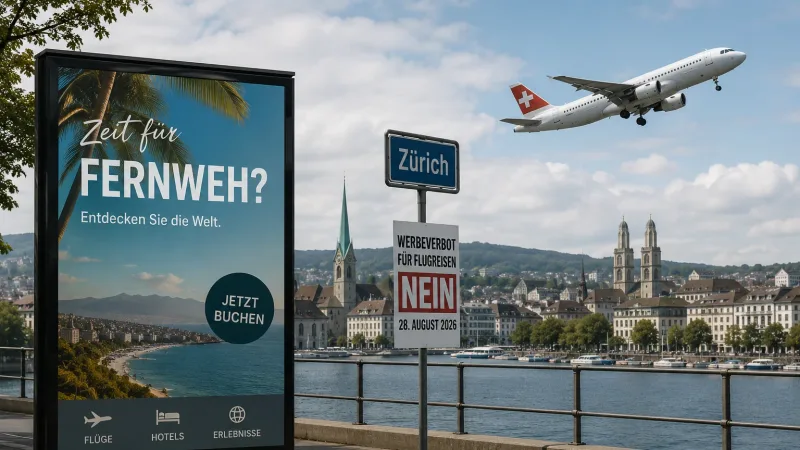
The Zurich City Council narrowly rejected a ban on advertising for air travel. A Green Party motion, which called on the City Council to examine a ban on air travel advertising in public spaces, failed by 61 votes to 57. The vote shows how controversial the question is: Should the state restrict advertising for particularly climate-damaging services?
The debate is not limited to Zurich. Other cities are also examining whether public advertising for air travel, combustion engine cars, or fossil fuels is still appropriate. A global movement against so-called "fossil advertising" is growing. However, no general ban on air travel advertising is currently impending at the federal level in Switzerland.
Zurich narrowly rejects the motion
The vote in the Zurich City Council was extremely close. 57 members voted for the motion, 61 against it. The Green Party argued that advertising helps make air travel appear as a natural part of everyday life. If politics aims to reduce air traffic for climate reasons, it must also address how air travel is advertised.
The bourgeois parties rejected the motion. According to SRF, FDP City Councillor Patrik Brunner spoke of an infringement on economic and advertising freedom. This highlights two differing views: one side sees advertising as a tool that shapes demand. The other considers it part of a free market economy where consumers should decide their own behavior. citeturn0search0
Advertising influences behavior – but how much?
Proponents of a ban do not argue that a single poster triggers a flight. Their thesis is more fundamental: if air travel is constantly and attractively advertised, it can contribute to flying being perceived socially as a normal and straightforward form of travel.
The City of Zurich is already addressing why people continue to fly frequently despite their awareness of climate change. A study commissioned by the city concludes that alongside psychological factors, structural reasons also play a role. These include prices, travel time, comfort, and the availability of alternatives. citeturn1search9
However, it is not yet proven that an advertising ban would reduce air traffic to a significant extent. This is one of the contentious points in the political debate.
Bern shows: Legal questions are complicated
Zurich is not the first Swiss city to address such a ban. In Bern, a motion for a ban on advertising posters for air travel and cars was already submitted in 2023.
The Bern City Council concluded in March 2026 that an explicit ban on advertising for air travel, airlines, and cars could generally be legally possible, provided it is anchored at the appropriate municipal regulatory level. At the same time, it pointed to significant demarcation problems and additional implementation effort. The question of what exactly constitutes advertising for a flight or air travel would be particularly difficult. citeturn1search60turn1search2
This shows: an advertising ban would not simply be a political declaration of intent. It would need precise definition and must operate within the current legal framework. Economic freedom must be considered, as must any public interest in climate protection. SECO generally states that state restrictions on economic freedom must be based on an appropriate legal basis, be in the public interest, and be proportionate. citeturn1search4
Other cities go further
Internationally, examples already exist. In Den Haag, a ban on certain climate-damaging advertising in public spaces has been in effect since early 2025. This includes advertising for air travel, cruises, combustion engine vehicles, and fossil fuels, among others.
According to SRF, more than 50 cities worldwide have since joined the movement against "fossil advertising" and introduced corresponding restrictions. These include Edinburgh, Florence, Stockholm, and Sydney, among others. citeturn0search0
However, the measures differ significantly. There is no uniform model for an international advertising ban. Some cities completely prohibit certain products, while others only restrict advertising in public spaces.
Switzerland initially relies on other instruments
At the federal level, Switzerland is currently pursuing a different approach. From January 1, 2027, air travel providers must state the estimated flight emissions per passenger for their flight offers. The regulation applies to airlines, travel agencies, and online travel operators, among others. citeturn0search35turn0search9
This aims to help consumers better understand the likely climate impact of air travel. It is therefore not a ban, but additional information during the purchasing decision.
Regulations already exist for price advertising. For flight offers in Switzerland, the total price must be stated, including fuel, airport, and security fees, as well as other charges. citeturn0search8
What does an advertising ban achieve?
Whether a ban on air travel advertising would actually lead to fewer flights is the key unanswered question. Proponents see it as a building block of a more comprehensive climate policy. Opponents doubt its effectiveness and warn against an infringement on advertising and economic freedom.
A practical problem also arises: a ban would need to clearly define what would be affected. Would only a poster advertising "Flight to Barcelona from 49 francs" be prohibited? What about advertising from an airline that also offers train travel or other services? And how would online advertising, which is not limited to a specific urban area, be handled?
The debate is likely to continue
The narrow decision in Zurich is therefore unlikely to end the discussion. Rather, it shows how controversial the handling of air travel has become in climate policy.
No general advertising ban for air travel is currently emerging for Switzerland. However, cities can discuss their own rules for advertising in public spaces. Simultaneously, the federal government will focus on more transparency regarding air travel emissions from 2027.
The actual political question thus goes beyond advertising: How much should the state influence the population's behavior when it comes to climate protection? Between a complete ban and a complete lack of regulation, numerous possibilities exist. Switzerland is only just beginning to debate this.
Sources
- SRF: Air Travel Advertising Ban – Long Overdue or Superfluous?, August 28, 2026
- SRF: Zurich City Parliament Rejects Air Travel Advertising Ban, August 27, 2026
- City of Bern: Motion 'No Advertising for Air Travel and Cars', March 16, 2026
- BAFU: Disclosure of Emissions for Flight Offers
- BAZL: Transparency in Flight Prices
- SECO: State and Competition
- City of Zurich: What prevents us from giving up flying