Arctic Becomes New Trade Route – Implications for Switzerland
Shorter Routes to Asia Attract Shippers – But Ice, Russia, and High Costs Slow Progress.
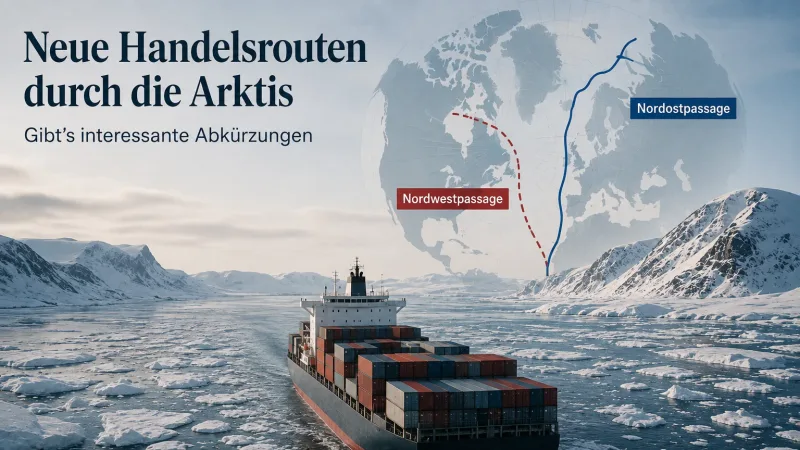
Melting ice makes the Arctic more accessible for international shipping. First container ships are already testing the route between Asia and Europe. This could open new opportunities for Switzerland, but for now, the Northern Sea Route remains primarily a geopolitical and logistical experiment.
A Shorter Route Between Asia and Europe
For decades, the Arctic was largely a natural barrier for commercial shipping. This is changing. The decline in Arctic sea ice extends the periods when ships can navigate certain routes in the high North. The Intergovernmental Panel on Climate Change (IPCC) assumes that sea ice loss has already increased the accessibility of Arctic sea routes. At the same time, it warns of significant ecological and security policy consequences.
Particular attention is on the Northeast Passage along the Russian Arctic coast. It connects the Pacific with the Atlantic and is significantly shorter between East Asia and Northern Europe than the traditional route via the Suez Canal. According to SRF, the distance can be about one-third less, depending on the origin and destination port. Fewer nautical miles potentially mean less fuel consumption and shorter transport times.
Practical proof, however, is still pending. In 2026, a South Korean and a Chinese container ship, among others, are testing the route. The South Korean PanStar Acro is expected to take around 40 to 45 days for its journey to Europe. Compared to the approximately 13,000 ships that pass through the Suez Canal annually, the number of Arctic transit voyages remains negligible.
Why the Shortcut is Not Automatically Cheaper
The shorter route has a crucial drawback: the Arctic remains a challenging area for navigation. Ice can block the route, weather conditions can change rapidly, and infrastructure for repairs, rescue, and medical emergencies is significantly less developed than on established trade routes.
This leads to additional costs for shipping companies. Depending on the route and season, ships must have an appropriate ice class or require icebreaker support. Insurance can also be more expensive. In the event of an accident in a remote Arctic maritime area, options for quick recovery would be limited.
The International Maritime Organization (IMO) has also banned the transport of heavy fuel oil in Arctic waters. This is due to the particularly severe consequences of an oil spill in a sensitive and difficult-to-access region.
The Russia Problem
For Western shipping companies, geography is not the only hurdle. A large part of the Northeast Passage lies along the Russian coast. Therefore, using the route requires cooperation with Russian authorities.
Since the Russian invasion of Ukraine, this cooperation has been politically sensitive. Sanctions, insurance issues, and dependence on Russian infrastructure can pose a significant risk for Western companies. China can cooperate more closely with Russia and therefore uses the route more assertively. Russia itself is also expanding the Northeast Passage and increasingly uses it for transport to Asia.
Thus, the Arctic becomes more than just a new shipping route. It is evolving into a geopolitical space where Russia, China, the USA, Canada, and European states pursue their interests.
What Switzerland Gains From It
For Switzerland, a new trade route initially sounds like a fringe issue. The country has no sea access of its own. However, Swiss companies are closely integrated into international supply chains. Machinery, pharmaceuticals, chemical products, and numerous other goods are produced, transported, and sold worldwide.
An additional connection between Asia and Europe could become interesting in the long term if it becomes reliable, economical, and politically predictable. Shorter transport times could bring advantages, especially for time-sensitive supply chains. At the same time, companies could further diversify their transports, becoming less dependent on individual bottlenecks such as the Suez Canal.
This is particularly relevant at a time when geopolitical conflicts repeatedly affect traditional trade routes. Attacks on shipping in the Red Sea have shown how quickly an important trade route can become more expensive or change. The Arctic could therefore become an interesting additional option in the long term – not necessarily as a replacement for the Suez Canal, but as another connection in the global logistics network.
Switzerland Monitors Developments
Bern has been engaged with the Arctic for some time. Switzerland has held observer status in the Arctic Council since 2017. The Federal Department of Foreign Affairs (EDA) describes the polar regions as strategically, ecologically, and economically increasingly important. Switzerland advocates for peaceful, stable, and sustainable development there, contributing its scientific expertise, among other things.
Thus, Switzerland also has its own interest in how the new sea routes develop. The question is not only whether Swiss companies will eventually transport goods via the Arctic. Crucial is also what rules apply there, who controls the routes, and how environmental and safety standards are enforced.
Climate Change Opens the Route – and Exacerbates the Problem
Perhaps the greatest irony of the new trade route is that its economic attractiveness is increasing due to a development that simultaneously causes enormous risks: climate change.
The IPCC notes that Arctic sea ice has significantly declined for decades. Warming is changing ecosystems, habitats, and the livelihoods of indigenous populations. At the same time, the retreating ice creates new opportunities for shipping and resource extraction.
Increased shipping traffic, in turn, would bring new environmental burdens. These include underwater noise, additional emissions, the risk of accidents, and the potential introduction of non-native species. The IPCC therefore sees both economic opportunities and significant ecological and geopolitical risks.
Not Yet a Rival to the Suez Canal
Therefore, there is no talk yet of a revolution in global trade. The number of ships is small, infrastructure is inadequate, and political risks are high.
However, the development is strategically interesting. If ice-free periods lengthen, shipping technology improves, and infrastructure expands, the Northeast Passage could gain importance in the long term. For Switzerland, this would primarily be a question of supply chains, supply security, and geopolitical diversification.
The Arctic is thus becoming a new arena for global trade. For Swiss companies, the route is not yet an easily bookable alternative today. But it could become an additional option in the future – provided that economic viability, safety, and international rules keep pace with the melting ice.
Sources
- SRF: "New Trade Routes – Interesting Shortcuts Through the Arctic"
- IPCC: Reports on Polar Regions, Sea Ice, and Arctic Shipping
- EDA: Switzerland's Information on Polar Regions
- Reuters: Test Voyage of a South Korean Container Ship via the Northeast Passage
- Federal Office for Customs and Border Security: Swiss Foreign Trade Statistics