Copernicus expects more than 1.5 degrees of warming again in 2026
After the warmest October in the ERA5 series, the probability of an annual mean above 1.5 degrees is over 99 percent. For the Paris climate target, however, the long-term development is what counts.
According to the current forecast from the European climate service Copernicus, 2026 will almost certainly be another calendar year with more than 1.5 degrees of global warming. The statistical model puts that probability at over 99 percent. For the annual average, the prediction range compared with the pre-industrial reference period 1850–1900 is 1.56 to 1.61 degrees.
The calculation takes the first ten months into account and estimates the values still outstanding for November and December. Second place behind the record year 2024 is the most likely outcome. However, Copernicus also gives a roughly 20 percent chance that 2026 will match or exceed the previous high. This is not yet a completed annual balance. The model was trained on ERA5 data from 1979 to 2025 and uses, among other things, recent land and sea temperatures.
October set a new monthly record
Global near-surface air temperature averaged 15.35 degrees in October. That made it the warmest October in the ERA5 series. Compared with the estimated pre-industrial October, the anomaly was 1.75 degrees. It was the third month in a row above 1.5 degrees.

Two reference periods for the same warming
Copernicus also reports temperatures against the 1991–2020 average. The World Meteorological Organization recommends this more recent reference for monitoring today's climate. It is not interchangeable with the pre-industrial baseline. A smaller deviation from this more recent, already warmer comparison period therefore does not automatically describe weaker warming.
ERA5 goes back to 1940 and is a global reanalysis: it reconstructs the state of the atmosphere from observations and model calculations. Comparing with 1850–1900 therefore also requires an estimate derived from several historical temperature datasets. For global annual means, Copernicus adds a standard offset of 0.88 degrees to the anomaly relative to 1991–2020; for monthly values this offset varies.
The measured quantity is also defined. In ERA5, near-surface air temperature refers to the temperature at two metres above land and sea. It is not the same as water temperature. When reading different temperature reports, the reference period, spatial coverage and measured variable must therefore match.
Paris judges more than one calendar year
The Paris Agreement aims to hold warming well below two degrees and to pursue efforts to limit it to 1.5 degrees. What is meant is a long-term level of global warming. A single warm month or a single year therefore does not on its own decide whether that level has been reached.
In a publication by the UK Parliamentary Office of Science and Technology (POST), the climate researchers Hayley Fowler and Richard Betts explain that a 20-year mean is usually considered for this purpose. This is intended to distinguish natural fluctuations between individual years from the long-term, human-made trend. A current estimate can combine observations from the past decade with model projections for the next.
Short-term exceedances are not an insignificant blip, however. The researchers describe a year above 1.5 degrees as an early signal of approaching the long-term level. Moreover, the global mean is not a temperature target for every place: land generally warms faster than oceans. The global mean therefore cannot be used to read off an equally large rise for Switzerland or for a single summer.
The duration of an overshoot remains changeable
In its report "Limiting Overshoot", presented in September 2026, the UN Environment Programme UNEP examines how the level and duration of an overshoot can be limited. It calls for rapid, sustained reductions in greenhouse gas emissions and at the same time adaptation to the consequences. Risks would grow with every additional fraction of a degree and with the duration of higher temperatures.
According to UNEP, a later return below 1.5 degrees would additionally require removing CO₂ from the atmosphere. This should supplement emission reductions, not replace them. The organisation also warns that a falling temperature does not fully reverse losses that have already occurred.
The still missing November and December values will decide the exact annual figure. How long the Earth stays at this high temperature level, by contrast, does not depend on the ranking of two record years, but on further greenhouse gas emissions.
Sources
- Copernicus C3S: Surface temperatures and annual forecast, October 2026
- Copernicus C3S: Data basis and reference periods
- POST: Hayley Fowler and Richard Betts on the 1.5-degree warming level
- UNEP: Limiting Overshoot, press release of 2 September 2026
- Deutsche Welle: Climate forecast for 2026
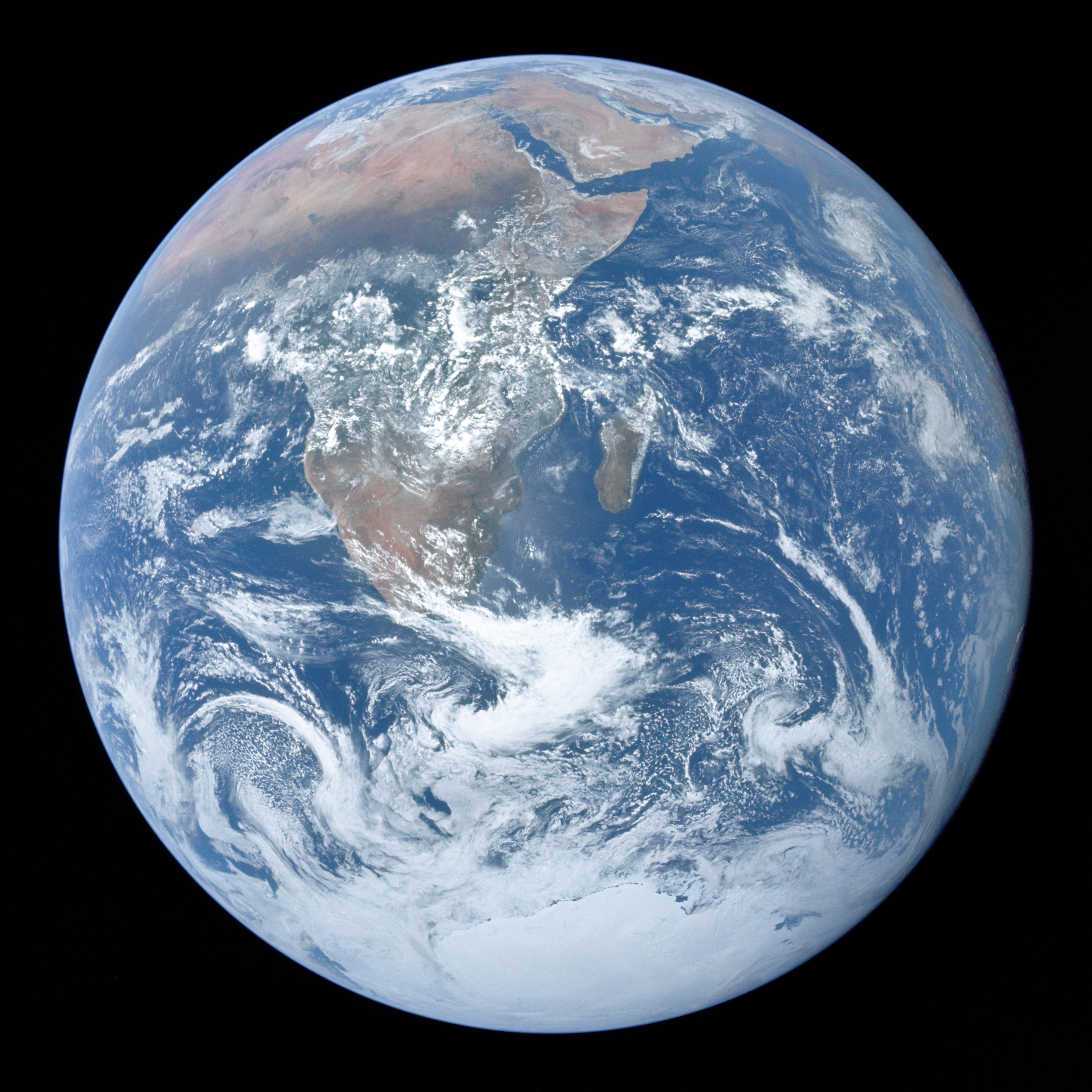
- Title image: NASA / Apollo 17, The Blue Marble (remastered), public domain
- Article image: CambridgeBayWeather, Stevenson screen exterior, public domain


