Glyphosate in Lebanon: Where is the Swiss Voice?
Israel sprays herbicide, Switzerland provides humanitarian aid – an FDFA position is missing.
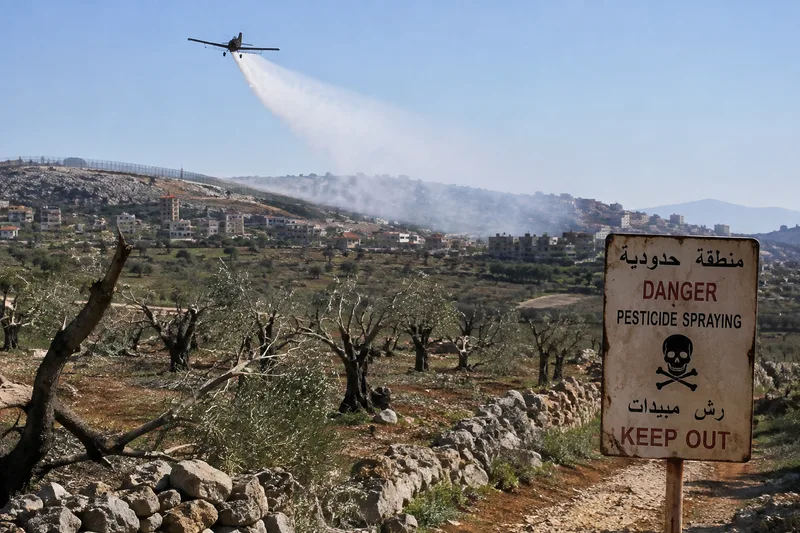
In South Lebanon, residues of the herbicide glyphosate were detected in soil samples after an Israeli air operation in February. Lebanese authorities report unusually high concentrations and filed a complaint with the UN Security Council in June. Israel has not yet confirmed the use of the substance. The focus is on the purpose of the spraying operation and its consequences for agriculture and the environment.
On February 1, 2026, the Israeli army informed the UN peacekeeping mission UNIFIL of an air operation along the Blue Line between Israel and Lebanon. According to UNIFIL, Israel described the substance used as «non-toxic» and asked peacekeepers to stay away from the area or seek shelter.
Subsequently, soil samples were taken in the affected areas. According to the Lebanese Ministry of Agriculture and Environment, glyphosate was detected. A later United Nations report also confirmed that laboratory analyses identified the herbicide in the samples. Israel has not yet publicly commented on the accusations.
Unusually High Concentrations
Concentration levels vary depending on the source. Lebanese Agriculture Minister Nizar Hany told ARD that values were 30 to 50 times higher than in typical agricultural application. Earlier statements from Lebanese authorities and other reports sometimes cited 20 to 30 times elevated levels.
In June, the Lebanese Foreign Ministry published further details. According to these, glyphosate concentrations of up to 22,750 micrograms per gram were found in soil samples from Aita al-Shaab, Ras al-Naqoura, and Dhayra. The Lebanese government based its complaint to the UN Security Council and the UN Secretary-General on these results.
However, the different figures should not be compared directly. Critical factors include the specific sample tested, the measurement method, and the reference value used. Publicly available sources do not allow for a complete assessment of how representative individual samples are for the entire affected area.
What is Glyphosate?
Glyphosate is a widely used herbicide. It acts non-selectively against individual weed species, damaging plants treated with the active ingredient. In agriculture, it is used for weed control, among other purposes.
The International Agency for Research on Cancer (IARC), an agency of the World Health Organization (WHO), classified glyphosate as «probably carcinogenic to humans» in 2015. Other authorities assess the health risk differently when used as intended. The IARC classification does not specifically mean that every exposure inevitably causes cancer.
What are the Consequences for Agriculture?
The incident is particularly problematic for agriculture in South Lebanon. The region had already suffered severe damage during the fighting. According to the Lebanese Agriculture Minister, the area affected by the spraying operation extends for approximately 18 kilometers along the border.
In South Lebanon, olives, tobacco, and other agricultural products play an important role in the population's income. Agriculture was already burdened by hostilities, fires, and the destruction of cultivated areas.
How long the affected soils and vegetation will recover from this specific spraying operation cannot currently be determined reliably. The long-term effects on soil, water, animals, and ecosystems have also not yet been conclusively clarified by publicly available studies.
Why Was the Substance Sprayed?
There is no publicly confirmed Israeli statement regarding the exact objective of the operation. The Tagesschau analysis mentions two possible military reasons: firstly, to reduce vegetation to provide less cover for armed groups. Secondly, the potential creation of a controlled buffer zone along the border is discussed.
However, a deliberate intention to permanently destroy the livelihood of the civilian population has not been proven. This distinction is important: the effects of a measure can be significant without automatically establishing its specific intent.
Lebanon Brings Case Before United Nations
The Lebanese government has now officially raised the incident internationally. On June 10, 2026, the Lebanese Foreign Ministry submitted a complaint to the UN Security Council and the UN Secretary-General, based on a report by the National Council for Scientific Research.
Lebanon argues, among other things, that the use of herbicides as a method of warfare is prohibited under the Chemical Weapons Convention. However, whether the specific incident actually constitutes a violation of international law has not yet been conclusively decided. The complaint is primarily the legal and political position of the Lebanese government.
Is Syria Also Affected?
According to available reports, the spraying operations were not limited to Lebanon. Similar incidents were also reported from the Syrian border region. However, the publicly available evidence for these cases is less detailed than for South Lebanon.
Therefore, these statements should not be equated. For Lebanon, documented samples and a subsequent official government complaint are available. For reports from Syria, the available information is less comprehensive.
Switzerland Supports Lebanon
Switzerland is engaged both humanitarianly and diplomatically in Lebanon. The Federal Department of Foreign Affairs (FDFA) allocated a total of 13.5 million Swiss francs for humanitarian aid in the Middle East in 2026. Of this, 5.5 million Swiss francs are earmarked for Lebanon.
During a visit to Lebanon in early July 2026, representatives from the FDFA and the Swiss Agency for Development and Cooperation (SDC) gathered information on the humanitarian situation. According to the FDFA, more than 700,000 people were internally displaced in Lebanon by the end of June; approximately 52,000 of them lived in collective shelters. Since March, over 4,200 fatalities and more than 12,000 injured have been registered as a result of the fighting.
Switzerland is thus engaged through both humanitarian aid and its «Good Offices.» In July, the FDFA held political discussions with Lebanese authorities, explicitly addressing the situation in the south of the country.
What Does Bern Say About the Glyphosate Allegation?
A specific public statement from the FDFA regarding the glyphosate incident is not apparent in the official sources analyzed. However, this does not mean that a particular Swiss stance can be inferred.
Switzerland finds itself in a dilemma: while providing humanitarian aid and offering its Good Offices in Lebanon, it must distinguish between political positioning, established facts, and an unresolved international legal assessment when evaluating specific allegations against a party to the conflict.
What is Established – and What Remains Open
It is established that Israel had announced an air operation to UNIFIL in February involving a chemical substance described as «non-toxic». According to Lebanese authorities and later a UN report, glyphosate was detected in subsequent soil samples. The Lebanese government formally complained about the incident to the UN Security Council in June.
Conversely, what remains open is the exact military intent behind the operation, the actual size of the affected area, and the long-term consequences of the measured concentrations for soils and ecosystems. Similarly, the international legal assessment of the specific incident has not been conclusively clarified.
This distinction is crucial, especially in a politically highly sensitive conflict. The documented findings must be taken seriously – at the same time, no further facts or intentions should be inferred from them that have not yet been substantiated.
Sources
- Tagesschau: Why Israel Sprays Herbicide in Lebanon, February 12, 2026
- FDFA: Switzerland Sets Diplomatic and Humanitarian Priorities in Lebanon at a Key Moment, July 6, 2026
- FDFA: Switzerland Provides 13.5 Million Francs for the Middle East, May 21, 2026
- L'Orient Today: Lebanon files complaint against Israel over glyphosate spraying, June 14, 2026
- United Nations: Report with Information on UNIFIL and the Spraying Operation
- 20 Minuten: Glyphosate Use in Syria and Lebanon, August 6, 2026
- Süddeutsche Zeitung: Israel Sprays Glyphosate in Syria – Farmers Face Ruin