Home ownership is getting pricier – but not every flat gains value
The FSO index rises 1.7 percent in the third quarter. Yet flat prices are falling in rural areas. What the average measures – and what buyers cannot infer from it.
Swiss home ownership became more expensive again in the third quarter of 2026. The residential property price index of the Federal Statistical Office (FSO) rose 1.7 percent compared with the previous quarter. But the figures published on 27 October do not show a broad upswing: prices fell in individual housing markets. Anyone planning a purchase or wanting to sell their house should therefore look behind the headline number.
The index reaches 129.8 points on a base of 100 in the fourth quarter of 2019. Compared with the third quarter of 2025, the increase is 4.4 percent. The two rates answer different questions: 1.7 percent describes the movement within a single quarter, 4.4 percent the movement over a year. They must not be confused with one another, nor simply extrapolated into another year.
Houses are rising faster than flats
Single-family houses became 2.1 percent more expensive than in the previous quarter on a national average, owner-occupied flats 1.3 percent. Over the year the order is reversed: houses are up 3.3 percent, flats 5.4 percent. The latest quarterly movement and the longer-term development therefore need not tell the same story.
The regional differences are also pronounced. For home ownership overall, the FSO records the sharpest quarterly increase in urban municipalities of a small agglomeration or outside any agglomeration: 3.4 percent. In intermediate municipalities it is 0.6 percent. These groups are municipality types, not cantons. They cannot be used to construct a robust ranking of all cantonal property markets.
The breakdown by property type is particularly revealing: in rural municipalities, single-family houses became 3.1 percent more expensive than in the previous quarter. Flats in the same group of municipalities, by contrast, became 1.9 percent cheaper. For flats in intermediate municipalities the decline is 0.3 percent. These figures alone refute the idea that every Swiss home has automatically become more expensive of late.

Sale prices, not listings
The IMPI measures prices actually paid in transactions for single-family houses and owner-occupied flats. That distinguishes it from analyses of properties on offer. A listing first documents an asking price; a purchase contract the negotiated price. Both can be useful for observing a market, but they are not the same thing.
The data come from large mortgage lenders. Purchases without mortgage financing are not captured in this survey. Gifts, advance inheritances and preferential prices are likewise not among the observed market transactions. A broad indicator is therefore not the same as a complete register of all ownership transfers.
There is also a statistical challenge: different houses are sold in one quarter than in the next. More large, well-located properties would raise a simple average even without any general increase in prices. The FSO therefore takes account of the characteristics of the buildings and their location in what is called a hedonic model. This quality adjustment is meant to tease out comparable price movements; it does not replace a viewing or an individual valuation.
The recorded purchase price covers the building and the land. Additional acquisition costs such as notary, land registry and bank fees are not part of the index. For a personal purchase budget they must be considered separately. Even an unchanged index figure would therefore not mean that a buyer's entire bill stays unchanged.
The index is not a mortgage decision
For prospective buyers, financing remains a separate question. In mortgage lending the FINMA emphasises affordability as well as cautious valuations. The self-regulation rules it recognises were adjusted at the start of 2025. A higher market index proves neither that a particular asking price is appropriate nor that a household can bear the running costs over the long term.
Nor should index weights be equated with sales figures. The weighting follows transaction volume; it does not follow that the corresponding share of all Swiss households has bought. The published results table does not state a complete number of all ownership transfers. Nor can the cause of the latest price rise be determined from it alone.
For a price comparison, property type and municipality group should therefore match first. Comparing a flat in the countryside with the nationwide house index would here even obscure the sign of the latest development. Even within one group, condition and location can differ considerably.
The federal figures thus give buyers and owners orientation, but no personal price guarantee. What matters remains the specific property, the local market and solid financing. A rising average in particular makes looking at the differences more important – not superfluous.
Sources
- FSO: residential property price index in the third quarter of 2026 and full results table
- FSO: definition and scope of the IMPI
- FSO: data and sources of the IMPI
- Eurostat: methodological description of the Swiss property price index supplied by the FSO
- FINMA: recognition of the self-regulation for mortgage financing, 27 March 2024
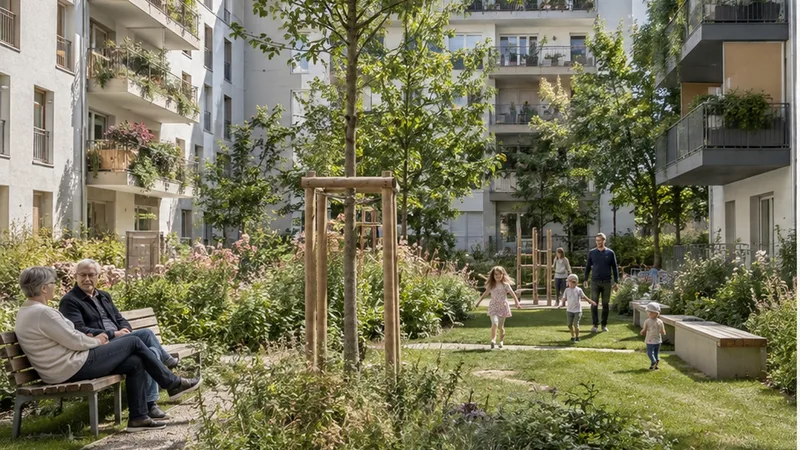
- Lead image: Sojujo, residential buildings on Bielstrasse, Wikimedia Commons
- Image licence: CC BY-SA 4.0
- Article image: Hadi, Federal Statistical Office, Wikimedia Commons
- Image release: CC0 1.0