Lobbying in the Federal Palace: How Transparent is Swiss Politics?
Interest representation is part of democracy. But paid mandates and political networks raise questions about influence and transparency.
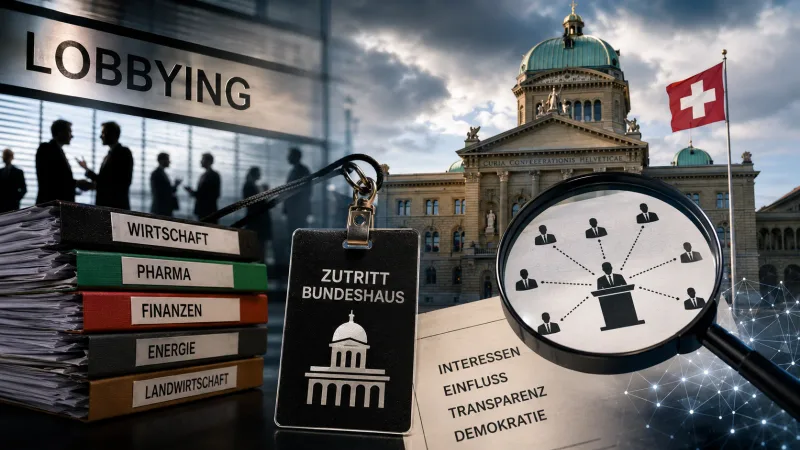
Debates are not the only activity in the Federal Palace. During sessions, conversations, events, lunches, and meetings also occur with representatives of various interest groups. Lobbyists are part of the daily political routine in Bern.
This is not necessarily problematic. A parliament cannot be knowledgeable about every detail of the economy, healthcare, agriculture, or energy policy. Associations, companies, unions, and organizations contribute expertise and diverse perspectives to political discussions.
Therefore, the crucial question is not whether lobbying should be permitted. It is: How transparent must influence be so that the public can understand which interests lie behind political positions?
Lobbywatch Aims to Make Connections Visible
One of the most well-known platforms addressing these questions is Lobbywatch. According to its own statements, the association collects and researches information on conflicts of interest, mandates, and organizations. Its database now includes more than 50,000 records.
Lobbywatch describes itself as a non-profit and independent organization. According to its own statements, the association is financed through members and donations. Its stated goal is a mandatory lobbying register, more transparency regarding mandate income, and effective controls.
The database can be a useful research tool for journalists, researchers, and interested citizens. It reveals which parliamentarians, in addition to their political mandate, hold, for example, board of directors, consulting, or association mandates.
At the same time, the figures must be contextualized: Lobbywatch is itself an actor in the political debate and pursues a specific goal of greater transparency. Its research is therefore an important source, but – especially for far-reaching claims – should be cross-referenced with official data and other independent sources.
What Parliamentarians Must Disclose
Switzerland already has transparency rules. Council members must disclose their conflicts of interest. These include professional activities, functions in management and supervisory bodies, consulting and expert activities for federal agencies, and permanent management or consulting activities for interest groups.
Since 2019, it must also be stated whether certain mandates are paid or voluntary. This information is published in a publicly accessible register by the parliamentary services.
However, the rules do not go as far as requiring the disclosure of the specific amount of compensation for a mandate. Lobbywatch criticizes precisely this gap. The association therefore regularly ascertains which parliamentarians disclose their income from paid mandates.
Only a Quarter Discloses All Mandate Income
Lobbywatch's latest survey is from 2025. It shows that 27 percent of council members fully disclose all income from paid mandates. Another 29 percent disclose at least some of their income. According to the survey, 44 percent do not disclose any such income.
Lobbywatch combines fully and partially transparent council members into a figure of 56 percent. However, this number should not be equated with a general “transparency rate” of parliament. It specifically describes the disclosure of income from paid mandates to Lobbywatch.
Caution is also advised regarding developments over the years. Lobbywatch attributes the increase in disclosure it measured, among other things, to its own work. However, it cannot be inferred that this development was caused exclusively by the association.
The Militia System Creates a Field of Tension
Part of the problem is linked to the Swiss political system itself. The parliament is not a classic professional parliament. Many council members continue to pursue a profession or hold mandates in companies, associations, and organizations.
This has an advantage: politicians bring experience from the world of work, business, and society to Bern. This knowledge can be valuable in legislation.
However, the same mechanism also creates a field of tension. For example, someone who works for an association and simultaneously votes on laws affecting its industry may have multiple interests at once.
Parliament itself states that such conflicts of interest are not automatically impermissible. Rather, they should be made transparent. A council member may generally pursue other professional and part-time activities in addition to their parliamentary mandate. In the event of direct personal involvement in a political matter, the relevant conflict of interest must also be mentioned.
Thus, Switzerland relies much more heavily on disclosure rather than a general ban on ancillary mandates.
May a Politician Lobby for a Company?
Generally, yes. A paid mandate with a company or association does not automatically disqualify a parliamentarian from their political office.
Precisely for this reason, there has been a discussion for years about whether current rules are sufficient. Various parliamentary initiatives have already demanded greater disclosure of ancillary income or even restrictions on paid lobbying activities.
For example, in 2024, the Council of States rejected a parliamentary initiative that would have required the disclosure of ancillary income in income ranges. Proponents saw this as an important step towards greater transparency. Opponents pointed out, among other things, that additional professional activities are part of the Swiss militia system and that it must already be disclosed whether a mandate is paid or voluntary.
The fundamental question thus remains open: Is it enough for the public to know for whom a parliamentarian works – or should they also know how much they receive for it?
Parliamentary Groups as Interfaces
The close ties between politics and interest groups become particularly visible in parliamentary groups. Council members can form alliances on specific topics. Such groups are not part of the official parliamentary organization but can foster political debates and contacts.
Lobbywatch investigated parliamentary groups and their supporting organizations for the 2026 summer session. According to their research, 125 out of 136 groups are led by associations or lobbying agencies. This includes economic and professional associations.
This figure comes from Lobbywatch and should be understood as their research. It does not prove that the groups in question influence political decisions in the interest of their sponsors. However, it shows how closely parliamentary work and organized interests can be intertwined in Bern.
With lobbying agencies, the question also arises as to whose interests are actually represented. If an association leads a parliamentary group, the sender is usually identifiable. With an external agency, it can be more difficult for the public to understand who ultimately stands behind a political concern.
Lobbying is Not Automatically a Problem
Therefore, a political debate about lobbying must not slide into the simple equation “lobbying equals corruption.”
Interest representation is part of a pluralistic democracy. An agricultural association should be allowed to represent its concerns. Trade unions must be able to speak for employees. Environmental organizations introduce ecological arguments. Companies can draw attention to the economic consequences of a law.
Lobbying becomes problematic where access to politics heavily depends on financial means, or when it is no longer clear who is behind an intervention.
Ultimately, it concerns a question of political equality of opportunity: Can every relevant societal actor equally present their arguments – or do financially strong organizations have a structural advantage?
Switzerland Does Not Have a Comprehensive Lobby Register
This is one of the biggest weaknesses of the Swiss system. Switzerland has a public register of parliamentarians' conflicts of interest. However, there is no comprehensive, mandatory lobby register that systematically records clients, lobbyists, interests, and financial expenditures.
The Council of Europe's Group of States against Corruption, GRECO, has also identified a need for further action in Switzerland regarding integrity and lobbying. Therefore, the discussion about more binding rules is not limited to Lobbywatch.
A more comprehensive register could, for example, reveal who maintains political contacts on behalf of a company or association, which topics are being addressed, and which organization is behind an interest representation.
More Transparency or More Bureaucracy?
However, stricter rules would also come at a cost. An extensive lobby register would need to be maintained, controlled, and enforced. Furthermore, it would have to be clarified when a conversation counts as lobbying. Is a casual chat in the corridors of the Federal Palace already reportable? What about an invitation to a professional event? And how are journalists, scientists, or citizen initiatives handled?
Therefore, regulation must not make normal political contacts unnecessarily difficult. Transparency should make the democratic process more understandable – not block it with bureaucracy.
The Decisive Question is Not Lobbying Itself
Lobbying will not disappear from Swiss politics. Nor should it. A democracy thrives on diverse interests being heard.
Rather, what is crucial is whether the public can recognize who exerts influence, whose interests are represented, and what financial relationships lie behind them.
The Swiss system has created more transparency in recent years. At the same time, debates about paid mandates, parliamentary groups, and missing information on compensation show that questions remain open.
Therefore, the real challenge is not to prohibit interest representation. It is to make the boundaries between political office and economic interest so visible that citizens can themselves assess to whom a politician is beholden.
Because lobbying only becomes a democratic problem when influence is no longer traceable. The crucial question for Switzerland therefore is: How much transparency does a democracy need?
Sources
- Lobbywatch – Good to know who makes policy
- Lobbywatch – Research Projects and Transparency Report 2025
- Lobbywatch – Transparency in the Swiss Parliament: Only one in four council members discloses all income
- Lobbywatch – Parliamentary Groups in Lobby Control
- Swiss Parliament – Disclosure Obligation of Council Members
- Swiss Parliament – Council of States rejects more transparency on ancillary income
- GRECO – Evaluation of Switzerland on Integrity and Corruption Prevention