NVIDIA Exceeds Expectations: AI Boom Boosts Figures
The US chipmaker reports strong quarterly results. Stock turns positive. What this means for Swiss investors.
NVIDIA Significantly Exceeds Expectations – AI Boom Continues Apace
NVIDIA once again reported record figures in the second quarter of fiscal year 2027. Revenue rose to 96.2 billion US dollars, with net profit reaching 59.7 billion dollars. The US chip giant significantly exceeded analysts' expectations. Even more crucial for the stock market is the outlook: NVIDIA expects revenue of approximately 108 billion dollars in the current quarter.
The figures indicate that demand for computing power for artificial intelligence (AI) applications remains exceptionally high. NVIDIA benefits from this as a leading provider of processors and complete computing systems for AI data centers.
Revenue Rises to 96.2 Billion Dollars
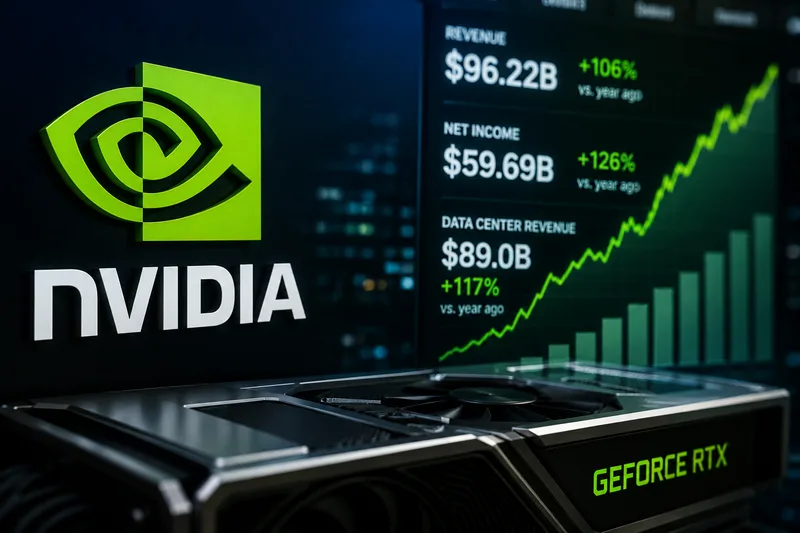
In the second quarter of fiscal year 2027, NVIDIA achieved revenue of 96.22 billion US dollars. In the prior-year quarter, it was 46.74 billion dollars. Thus, the company more than doubled its revenue within one year.
Net profit increased from 26.42 billion to 59.69 billion dollars, representing a rise of approximately 126 percent. Earnings per share under US-GAAP were 2.46 dollars. On an adjusted basis, it was 2.22 dollars per share.
Analyst expectations were also surpassed. The consensus reported by finanzen.net was approximately 92.28 billion dollars in revenue and 2.09 dollars in adjusted earnings per share. NVIDIA thus exceeded forecasts for both revenue and earnings.
Data Centers Remain the Growth Driver
The most important business segment continues to be data centers. NVIDIA achieved revenue of 89.0 billion dollars in this area in the second quarter. This was 117 percent more than in the same period last year.
By now, the vast majority of the group's revenue comes from systems and processors for data centers. Demand is primarily driven by the expansion of large AI infrastructures. Cloud providers, technology companies, and AI developers are investing billions in new computing capacities.
NVIDIA sees not only the training of large language models as a growth driver. So-called inference – the application of already trained AI models – also increasingly requires computing power. In addition, new applications in robotics, autonomous vehicles, and so-called physical AI are emerging.
Outlook Also Exceeds Expectations
For the third quarter of fiscal year 2027, NVIDIA expects revenue of approximately 108 billion US dollars, with a fluctuation margin of plus or minus two percent.
Thus, the forecast is above analyst expectations. Particularly noteworthy is that NVIDIA's outlook does not include revenue from data center computing business in China. The development of US export restrictions therefore remains an uncertainty factor.
The gross margin for the upcoming quarter is projected to be around 74 percent. In the past quarter, it was 75 percent. Higher costs for memory and other components could put greater pressure on profitability in the future.
Vera Rubin Expected to Usher in Next Growth Phase
The new Vera Rubin platform plays a crucial role for the coming quarters. NVIDIA has reportedly ramped up its production.
The architecture is designed for particularly compute-intensive AI applications. This includes so-called agentic AI systems, which can not only generate answers but also autonomously plan and execute tasks.
NVIDIA expects the new platform to become a significant growth driver. This could further increase the demand for computing power.
Stock Initially Reacts Cautiously, Then Turns Positive
The stock market's reaction demonstrates how high expectations for NVIDIA have become. Although the company reported revenue and profit significantly above analyst estimates, the stock initially came under pressure in after-hours trading.
However, the share price subsequently turned significantly positive. finanzen.net recently reported an increase of 4.74 percent to 219.53 US dollars in after-hours trading. Other market reports also indicated a positive reaction to the figures and outlook.
The stock performance highlights a key challenge for NVIDIA: strong figures alone are no longer sufficient. Investors compare results with extremely high expectations. Therefore, it is increasingly crucial whether the company can continue to raise its forecasts.
The AI Boom Remains the Central Driver
NVIDIA CEO Jensen Huang remains very optimistic about the development. Demand for computing power continues to grow, as more companies and AI labs develop their own applications.
The figures also indicate continued exceptionally strong demand. NVIDIA almost doubled its data center revenue within one year and already expects group revenue of approximately 108 billion dollars in the next quarter.
For fiscal year 2027/28, management also anticipates revenue growth of around 70 percent. Should this forecast materialize, NVIDIA would continue to grow at a pace unusual for an established technology group, despite its already enormous company size.
However, Risks Are Increasing
The strong outlook does not mean NVIDIA is without risks. China remains a central uncertainty factor. NVIDIA's current forecast does not include revenue from data center computing in China.
Cost developments could also strain margins. Rising prices for memory and other components put pressure on the gross margin. At the same time, competitors like AMD, Broadcom, and other semiconductor companies are trying to gain market share in the AI business.
In addition, there is the question of how long the enormous investments in AI infrastructure will remain economically justified. Technology companies are currently investing billions in data centers. For NVIDIA, it is crucial that these investments lead to sustainably profitable AI applications.
Significance for Investors in Switzerland
NVIDIA's figures are also relevant for Swiss investors. The stock is one of the most significant titles in the global technology sector and is represented in numerous international stock indices and funds.
For investors in Switzerland, currency risk is an additional factor. NVIDIA is traded in US dollars. Therefore, a Swiss investor's return depends not only on the stock's price performance but also on the development of the US dollar against the Swiss franc.
The figures simultaneously illustrate the opportunities and risks of the AI boom. NVIDIA continues to grow exceptionally strongly, but the valuation and expectations for the company are commensurately high. Even minor disappointments in growth, margins, or the outlook can therefore lead to significant stock price movements.
What Is Now Crucial
For the coming months, three points will be particularly important: the speed of AI data center expansion, the introduction of the Vera Rubin platform, and the further development of the China business.
In addition, there is the fundamental question of whether the technology sector's high investments will actually lead to commensurately high returns. As long as demand for AI computing power continues to rise, NVIDIA remains one of the greatest beneficiaries of this development.
The second quarter provides a strong signal for this: the AI boom has not lost momentum for NVIDIA so far. The next test now lies with the outlook – and with the question of whether the company can maintain its exceptional growth pace even with even larger revenues.
Sources
- NVIDIA, "NVIDIA Announces Financial Results for Second Quarter Fiscal 2027", August 26, 2026.
- finanzen.net, "NVIDIA Stock Turns Positive: Profit and Revenue Exceed High Expectations", August 27, 2026.
- Reuters, "Nvidia forecasts 70% sales growth next year, signals AI spending boom has years left to run", August 26, 2026.
- Associated Press, "Strong AI chip demand fuels Nvidia's Q2 results well beyond Wall Street's expectations", August 26, 2026.