Switzerland's GDP: Data Situation Unclear After FSO Publication
Federal Statistical Office Shows Only a Diagram – Specific Figures Missing
Swiss Economy Grows – But What Reaches the Middle Class?
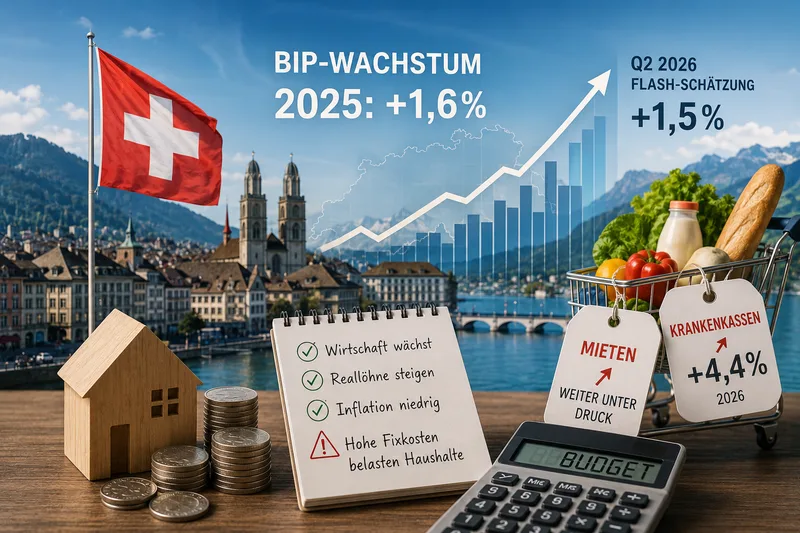
The Swiss economy grew by 1.6 percent in 2025. At the same time, real wages also rose by 1.6 percent, while average inflation was only 0.2 percent. The second quarter of 2026 also shows strong development with a preliminary growth of 1.5 percent. Nevertheless, the situation remains challenging for many households: health insurance premiums are rising significantly, the housing market remains tight, and the high prices of recent years have not disappeared.
The new figures from the Federal Statistical Office (FSO) and the State Secretariat for Economic Affairs (SECO) paint a generally positive picture of the Swiss economy. In 2025, real gross domestic product increased by 1.6 percent. This continued the growth from 2024, when GDP had risen by 1.5 percent.
However, economic growth alone does not indicate how the situation is developing for the population. For households, income, prices, rents, health insurance premiums, and other ongoing expenses are crucial. A more nuanced picture emerges here.
The Economy Grew by 1.6 Percent in 2025
The FSO reported an increase in real gross domestic product of 1.6 percent for 2025. Domestic demand developed particularly strongly, rising by 2.5 percent. Investments increased by 3.5 percent, making a significant contribution to growth.
Private consumption also developed positively. Consumption expenditures by private households and private non-profit institutions serving households rose by 1.8 percent. Expenses for health, transport, and hospitality particularly contributed to consumption growth.
Industry also developed positively. Manufacturing and the production of goods collectively increased by 2.4 percent. The chemical and pharmaceutical industry showed particularly strong growth of 8.1 percent.
The Swiss economy thus continues to grow, though not equally strong in all sectors. While industry, financial services, and parts of the service sector gained, individual sectors experienced declines.
2026 Also Begins with a Strong Signal
Even more current is the look at the current year.
According to SECO's flash estimate published on August 14, real Swiss GDP is expected to have grown by 1.5 percent in the second quarter of 2026 compared to the first quarter. This figure is seasonally, calendar, and sports event adjusted.
Industry, especially the chemical-pharmaceutical sector, again provided the decisive contribution. The service sector also developed positively overall.
However, the 1.5 percent is not yet the final result. The flash estimate is partly based on projected values. SECO's full quarterly accounts are to be published on September 3, 2026.
Wages Have Clearly Gained Purchasing Power Again
For employees, another figure is particularly important: the development of real wages.
In 2025, nominal wages in Switzerland rose by an average of 1.8 percent. Since prices increased by only 0.2 percent on an annual average, this resulted in real wage growth of 1.6 percent. The purchasing power of wages thus increased significantly.
This is a significant improvement compared to previous years. In 2023, real wages had fallen by 0.4 percent. In 2024, they rose again by 0.7 percent for the first time. In 2025, the recovery accelerated to 1.6 percent.
For employees, this means: the average purchasing power of wages has improved again. The Swiss middle class is therefore in a better position in terms of income than during the inflation phase.
Inflation is Now Hardly the Major Problem Anymore
Switzerland has largely left behind the major wave of inflation in 2022 and 2023.
Average annual inflation was still 2.1 percent in 2023 and 1.1 percent in 2024. In 2025, it fell to just 0.2 percent. Inflation also remains very low in 2026. In July, consumer prices were only 0.4 percent above the level of the same month last year. Compared to June, they even fell by 0.1 percent.
Switzerland is thus currently far from the high inflation rates that burdened many households just a few years ago.
However, low inflation does not mean that prices have returned to their former level. Inflation measures the change in prices. If inflation falls to 0.4 percent, prices only continue to rise slowly – but the price increases already achieved remain.
Why Life Still Doesn't Necessarily Feel Cheaper
For a household, the average inflation rate is only part of the equation. What the income is actually spent on is crucial.
Anyone who spends a large part of their income on rent, health insurance, energy, food, and other necessary expenses can experience a significantly different cost development than the average consumer price index basket.
This is particularly evident with health insurance premiums.
Health Insurance Premiums Rise Significantly More Than General Inflation
The average health insurance premium will increase by an average of 4.4 percent in 2026 to 393.30 Swiss francs per month. For adults, the average monthly premium is 465.30 francs, for young adults 326.30 francs, and for children 122.50 francs.
Thus, the development of health insurance premiums is significantly higher than the general inflation of 0.2 percent in 2025 or 0.4 percent in July 2026.
The FOPH explains the increase with higher healthcare costs, among other factors. These include the aging population, new treatment options and medications, increasing demand for healthcare services, and higher tariffs in inpatient and outpatient sectors.
For households, premiums are therefore a particular cost factor: they rise regardless of whether a family actually uses more medical services.
Pressure on Housing Also Remains
Another central cost block is housing.
The rental housing market remains tight in many regions. At the same time, the mortgage reference interest rate, which is important for rent adjustments, has now reduced to 1.25 percent. It has been at this level since September 2025 and has remained unchanged so far in 2026.
Falling financing costs can generally lead to rent reductions if the corresponding conditions are met. For example, the reduction of the reference interest rate from 1.5 to 1.25 percent in September 2025 generally resulted in a potential reduction claim of 2.91 percent, provided the rent was based on a reference interest rate of 1.5 percent.
However, the reality of the housing market is more complex. The Federal Housing Office continues to point to a tight rental housing market and scarce supply. At the same time, the development of the rental price index in 2026 is likely to weaken due to the reduced reference interest rates.
For tenants, this means: the reference interest rate now provides more relief, while the general scarcity of housing remains a problem.
The Middle Class Between Gaining Purchasing Power and High Fixed Costs
This presents a contradictory picture.
On the one hand, economic conditions are favorable: GDP is growing, inflation is low, and real wages are rising. In 2025, the purchasing power of wages increased by an average of 1.6 percent.
On the other hand, important household costs remain high. Health insurance premiums will increase by 4.4 percent in 2026. The housing market remains tight. And prices, which rose significantly during the inflation years, do not automatically fall back to their previous level.
This is precisely why two statements can be true at the same time: The Swiss population is regaining purchasing power on average – and many households still feel financially pressured.
Growth Does Not Reach All Households Equally
GDP measures the economic performance of all of Switzerland. It does not directly state how much money an individual household has available at the end of the month.
A household with sharply rising wages and a favorable housing situation can benefit significantly from the current environment. For a family with several children, high health insurance premiums, and an expensive rented apartment, the financial leeway can be considerably smaller.
The regional situation also plays a role. Housing and health insurance costs differ significantly depending on the canton and residential region. Therefore, the average development in Switzerland can only partially reflect the personal situation of an individual household.
Switzerland Remains Comparatively Stable Economically
In international comparison, Switzerland thus remains in a relatively comfortable position. Inflation is low, real wages are rising again, and the economy is growing.
However, this does not mean that Switzerland has become an inexpensive country. The price level remains high. For the middle class, the crucial question is therefore less whether inflation is at 0.4 or 0.8 percent. More important is whether incomes grow faster in the long term than those expenses that are hardly avoidable.
Housing, health, energy, food, and certain services are particularly relevant here.
What Becomes Crucial Now
The coming months will show whether the strong second quarter of 2026 is sustainable. The definitive GDP figure for the second quarter will be published on September 3. After that, it should be possible to better assess how strongly the Swiss economy actually grew in the first half of the year.
For households, it will simultaneously be crucial how wages, health insurance premiums, and housing costs continue to develop.
A particularly favorable combination would be a continuation of economic growth with simultaneously low inflation and rising real wages. Then the purchasing power of the middle class could continue to increase.
If, however, the prices for important fixed costs remain significantly higher than wages, the financial burden on many households could still feel high despite low overall inflation.
Conclusion: Good Economic Data, But No Free Pass for Households
The current figures generally speak for a robust Swiss economy. In 2025, GDP grew by 1.6 percent. Real wages also rose by 1.6 percent. At the same time, average inflation was only 0.2 percent.
The second quarter of 2026 also provides a positive signal. The preliminary SECO estimate indicates growth of 1.5 percent. However, the definitive figure is still pending.
For the population, this is initially good news. The purchasing power of average wages is rising again, and general inflation has largely disappeared.
However, the development of household budgets is more complicated. Health insurance premiums will increase by 4.4 percent in 2026, while the housing market remains tight despite the now lower reference interest rate.
So Switzerland is growing again – the crucial question now is how much of this growth actually reaches the population.
Sources
- Federal Statistical Office (FSO): "Gross Domestic Product – 1996–2025", August 25, 2026.
- Federal Statistical Office (FSO): "Wage Development 2025", April 21, 2026.
- Federal Statistical Office (FSO): "Consumer Prices Fell by 0.1% in July", August 3, 2026.
- State Secretariat for Economic Affairs (SECO): "Swiss GDP Growth Remained Stable in 2025", August 25, 2026.
- State Secretariat for Economic Affairs (SECO): "Flash GDP for Q2 2026: Strong Growth of the Swiss Economy", August 14, 2026.
- Federal Office of Public Health (FOPH): "Health Insurance Premiums Increase by an Average of 4.4 Percent", September 23, 2025.
- Federal Housing Office (FHO): Development of the Mortgage Reference Interest Rate, as of June 2026.