
Social assistance 2025: minors have the highest rate
4.8 percent of under-18s received support. The new FSO chart shows differences between population groups, but explains neither individual hardship nor the effect of policy measures.
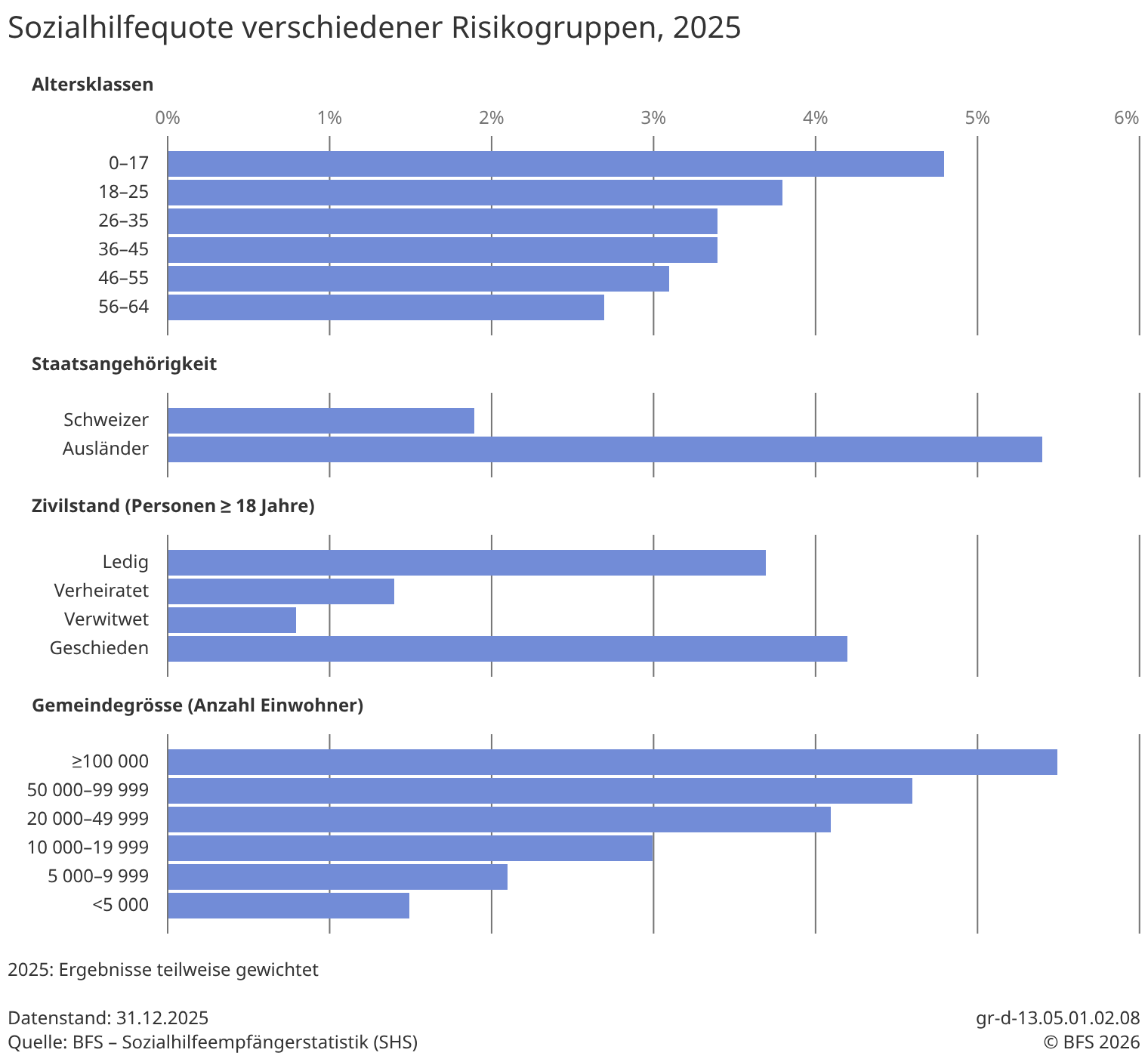
Children and young people had the highest social assistance rate of any age group compared by the Federal Statistical Office in 2025: 4.8 percent of under-18s received economic social assistance. That is what the risk chart published on 27 October 2026 shows. The national reference value is 2.9 percent.
The figure makes a particular burden visible. But it does not explain why a specific family needs support, and it does not measure the success of any single reform. That matters right now: the Conference of Cantonal Social Directors has decided on additional help for children, but implementation takes place at cantonal level.
The reference base determines what the figure says
4.8 percent does not mean that only 4.8 percent of all social assistance recipients are minors. The rate puts supported minors in relation to the corresponding reference population. The share of children among all recipients would be a different indicator with a different denominator.
For 18- to 25-year-olds the FSO reports 3.8 percent. For the 26 to 35 and 36 to 45 groups it is 3.4 percent each, and for 56- to 64-year-olds 2.7 percent. The published age chart ends with this group. It is therefore not a complete picture of all age brackets up to old age.
The term "risk" here denotes an observed difference between groups. It is not a personal prediction. A child's age alone says nothing about their future financial situation, nor about an inevitable later reliance on social assistance.
Marital status and household are not the same thing
The chart presents four characteristics separately: age, nationality, marital status and municipality size. It contains no separate breakdown by single parents or couple households with children. Such household types must therefore not be equated with the marital status categories.
Among adults, divorced people have a rate of 4.2 percent, married people 1.4 percent. It does not follow that divorce alone causes the difference. On families, the SKOS points to the interplay of higher costs and additional care work. After a separation, the money available may have to stretch to two households. That is an expert assessment, not an effect estimate isolated from this chart.
The rates shown by nationality are also unadjusted comparisons. 5.4 percent for foreign nationals and 1.9 percent for Swiss citizens say nothing on their own about the significance of age, qualifications or household composition.
A child supplement has been decided, but does not apply automatically everywhere
On 29 May 2026, the Conference of Cantonal Social Directors decided on an adjustment to the SKOS guidelines. In particular, a supplement of 50 francs per child per month to the basic subsistence needs is planned. The SODK aims to improve the development opportunities and social participation of children receiving support.
According to the SKOS release published on the matter, the SODK recommends that the cantons bring the changes into force by 1 January 2028 at the latest. This does not prove that the supplement is already being paid everywhere in October 2026. For a specific household, what counts is the applicable cantonal regulation and the individual calculation.
This distinction prevents a second misreading: the 2025 data cannot demonstrate the effect of a supplement that was only specified afterwards. Whether the measure reduces burdens would have to be examined after its introduction, using suitable data on income, expenditure and participation.
Later impact assessments must also take the modernised survey into account. The FSO labels the 2025 results as partly weighted and urges caution when comparing them with earlier years. A change in the bar alone would therefore not yet be a convincing record of impact.
Groups overlap, support remains individual
A child can live in a large municipality and hold a foreign nationality at the same time. The separate rates must therefore not be added together. Combined statements would require analyses that consider several characteristics together. A long list of high individual values is no substitute for that analysis.
The SODK describes social assistance as needs-based support geared to the individual case. In practice this means: the new chart helps identify groups with a frequent need for support. It does not replace an assessment of the actual hardship. The Swiss mandate is to enable appropriate help and educational opportunities – without turning group membership into a judgment about individual families.
Sources
- FSO: social assistance rate of various risk groups 2025
- FSO: results and methodological notes on social assistance 2025
- SODK: decision on the child supplement of 29 May 2026
- SKOS: revision of the guidelines and recommendation on the implementation date
- SKOS: family burdens and poverty risks
- SODK: responsibilities and individual needs-based benefits
- FSO: OPEN-BY terms of use for the original chart
- Title image: Hadi / Wikimedia Commons
- Title image licence: CC0 1.0

