
Social welfare and education: what 53.8 percent really shows
People without vocational training are clearly overrepresented among social assistance recipients. However, the new FSO chart measures no individual risks and is no comparison over time.
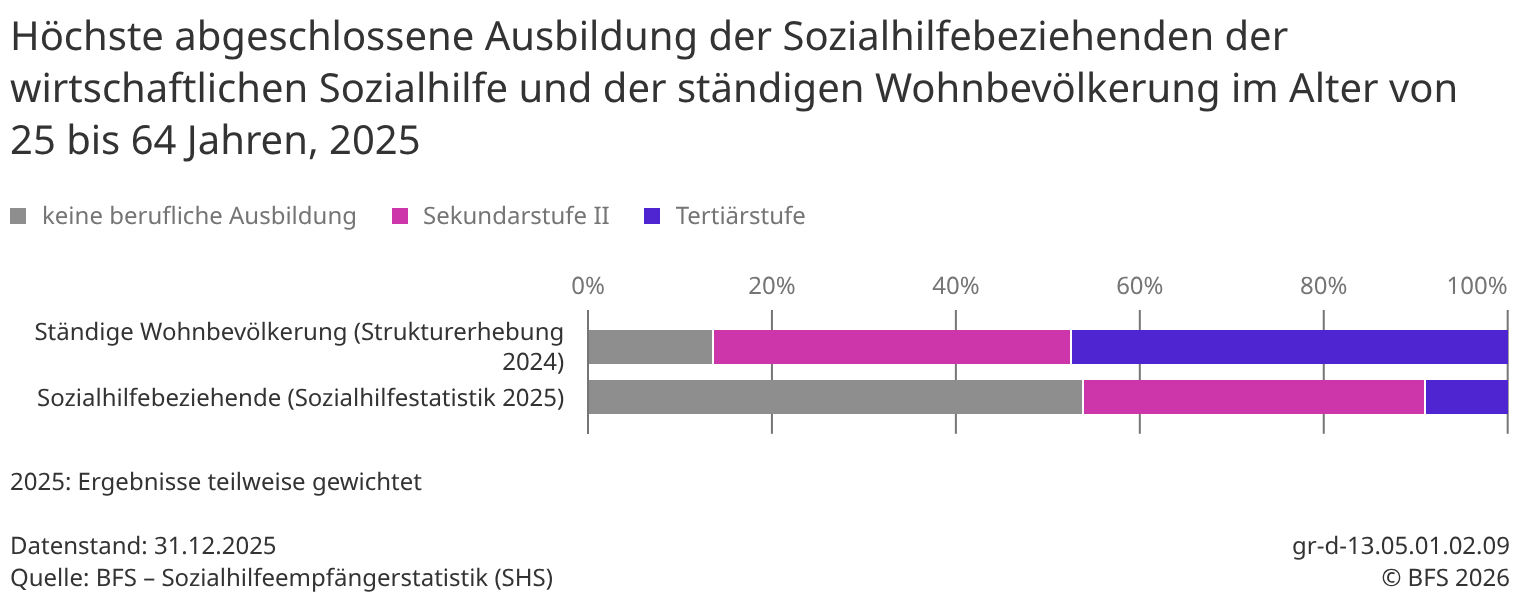
More than half of the social assistance recipients examined in the new FSO chart fall into the «no vocational qualification» category: the share is 53.8 percent. In the permanent resident population used for comparison it is 13.6 percent. The presentation published on 27 October 2026 thus makes a clear difference in the composition of two groups visible.
But it answers a different question than the one about a person's individual risk of needing social assistance. It does not follow that 53.8 percent of all people without vocational training receive social assistance. For that statement, the entire population in this education category would have to form the denominator. Here, the denominator is the social assistance recipients examined.
Two groups, two data sources
The chart limits the comparison to people aged between 25 and 64. Children, young people and people of retirement age are therefore not covered. The shares shown must not be transferred to all recipients across all age groups.
The dates also need to be read more precisely than the heading «2025» suggests. One bar is based on the 2025 social assistance statistics, the other on the 2024 structural survey. The FSO therefore compares two distributions with different reference years. It does not follow the same people over several years and does not show annual progress in education.
Upper secondary level accounts for 37.2 percent of social assistance recipients and 39.0 percent of the resident population compared. At tertiary level the figures are 9.0 and 47.3 percent respectively. Because of rounding, the three shares of the resident population add up to 99.9 percent. This does not create an additional, unnamed education category.
No qualification is not the same as no competence
What is recorded is the highest completed education, not every skill someone has acquired in working life or outside a formal course of education. The statistics are therefore not an aptitude test. Nor do they allow any judgement about how motivated an individual is or what work they can actually do.
The overrepresentation of the category without vocational training is nevertheless relevant. It shows that formal qualifications should not be treated as a marginal issue when planning support and career prospects. However, it does not prove that any given course immediately ends social assistance receipt for every affected person.
The National Poverty Monitoring describes education and poverty as a mutual relationship. Missing qualifications or basic skills can favour financial difficulties. Conversely, limited means can restrict educational opportunities. Education programmes are therefore one possible preventive measure among several, not an explanation for every hardship.
What adults can catch up on or have recognised
The Swiss careers guidance system names four routes to a federal certificate of proficiency or federal certificate of vocational training in adulthood: a regular or shortened apprenticeship, direct admission to the final examination, and the validation of educational achievements. Which route is an option depends on the person's career history and on the occupation they are aiming for.
Validation in particular makes the distinction between qualification and ability practical. According to the State Secretariat for Education, Research and Innovation, adults document competences they have already acquired in a dossier. They do not sit the regular final examination, but they must still demonstrate the required competences and the general education requirements.
This route is not open in every occupation. It requires corresponding regulations recognised by the State Secretariat; the cantons organise the procedure. Existing experience therefore does not automatically lead to a diploma. An individual assessment remains necessary, as does checking for any gaps in knowledge.
The next question concerns the right framework conditions
Anyone who wants to catch up on a qualification needs more than a statistical pointer. Admission, scheduling, support and financing all have to be clarified. The Canton of Bern bundles these questions in its programme for vocational qualifications for adults. For personal planning, the responsible cantonal guidance centres are the concrete starting point.
The new social assistance statistics have also been modernised methodologically. The FSO points to partly weighted results and to the limits of comparisons with earlier years. An apparent jump in one education group would therefore not readily amount to an education-policy record of success or failure.
For Switzerland this yields a precise task: take missing formal qualifications seriously, recognise existing skills and open up achievable training paths. The 53.8 percent mark a starting point. They are neither a personal forecast of the future nor a justification for reducing people to their last school-leaving certificate.
Sources
- FSO: Highest completed education, social assistance 2025 and structural survey 2024
- FSO: Modernisation and comparability of the social assistance results
- National Poverty Monitoring: Education and poverty
- Berufsberatung.ch: Four routes to a vocational qualification for adults
- State Secretariat for Education, Research and Innovation: Validation of educational achievements and its requirements
- Canton of Bern: Vocational qualification for adults
- FSO: OPEN-BY terms of use for the original chart
- Title image: Hadi / Wikimedia Commons
- Title image licence: CC0 1.0

