Swiss Flight LX14 Diverted to St. John's Due to Medical Emergency
Medical Emergency Onboard: Swiss Flight LX14 Makes Unscheduled Landing in St. John's.
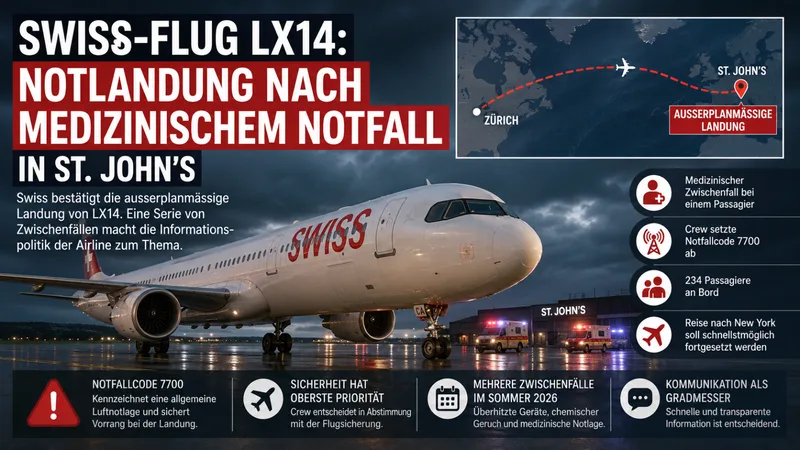
Zurich – A medical emergency forced Swiss Flight LX14 from Zurich to New York to make an unscheduled landing in Canada on Thursday evening. The aircraft was diverted to St. John's, Newfoundland.
Swiss confirmed the incident to the Keystone-ATS news agency. A passenger experienced a medical emergency. The cockpit crew therefore decided on an unscheduled landing in St. John's.
There were 234 passengers on board the Airbus. The affected passenger was to receive medical attention in St. John's. Afterwards, the aircraft was to be refueled and continue its journey to New York as quickly as possible.
Why the Crew Activated Code 7700
During the flight over the Atlantic, the crew activated transponder code 7700. This is the internationally used signal for a general air emergency.
However, the code does not automatically mean that the aircraft is in an immediately dangerous situation. It can be used for very different events – including medical emergencies.
In the case of LX14, Swiss stated that the signal was activated in consultation with local air traffic control. This allows air traffic to be handled with priority and enables the fastest possible landing.
"An emergency signal does not automatically mean there is a danger to passengers or the aircraft."Swiss Spokesperson Michael Pelzer
Thus, the current situation also differs linguistically from a classic emergency landing. Swiss explicitly refers to an unscheduled landing.
Several Incidents for Swiss This Summer
The LX14 incident adds to a series of other unscheduled landings and diversions of Swiss long-haul flights this summer. The causes varied and do not immediately suggest a common technical problem.
On July 27, flight LX16 from Zurich to New York had to divert to Bangor, Maine, in the US. Swiss later identified a headphone charging box as the cause of the smoke. The device had slipped into a seat and become wedged.
On August 10, flight LX52 from Zurich to Boston was diverted to Dublin. The cause was smoke on board, triggered by an overheated power bank belonging to a passenger.
Additionally, on August 25, LX9, en route from Chicago to Zurich, diverted to the Azorean island of Terceira. The reason was a pungent odor in Economy Class, the cause of which could not initially be determined. Approximately five passengers and one crew member underwent medical examinations as a precaution.
The three events thus had different triggers: a damaged charger, an overheated power bank, and a still-unclear odor. LX14, in turn, concerns a medical emergency.
No Automatic Indication of a Safety Problem
Diversions are fundamentally part of normal safety management in air transport. Pilots decide on them when circumstances make a landing at another airport sensible or necessary.
Therefore, a flight using emergency code 7700 is not, in itself, proof of a dangerous situation or a technical defect. Especially in medical emergencies, an unscheduled landing can be the safest and fastest solution.
According to Swiss, the cause for LX14 was clearly medical. The airline did not provide information on the specific health condition of the affected passenger.
How Quickly Does Swiss Inform?
This current case also raises a second question: How does an airline inform in such events?
The first information about flight LX14 spread via flight tracking services and media. Swiss then confirmed the medical emergency upon request. A separate announcement about the incident was not available on the airline's publicly accessible official channels at the time of research.
However, this does not mean that Swiss did not provide information. The airline confirmed the essential details and also explained the background of the emergency code. For passengers and relatives, it is still crucial that information is available as quickly, comprehensibly, and reliably as possible in the event of an incident.
What Remains Undetermined for LX14
The health condition of the affected passenger is not known. Swiss only stated that the person would receive medical attention in St. John's.
The exact time of onward travel to New York was also not yet determined at the time of publication. Swiss announced that the aircraft would be refueled after the passenger's care and the flight with the 234 passengers would continue as quickly as possible.
Thus, the LX14 case remains primarily a medical diversion – and not a confirmed technical safety incident. However, the accumulation of various incidents with Swiss in recent weeks makes the topic noteworthy. It is crucial not to conflate the individual events.
Conclusion
Swiss Flight LX14 had to make an unscheduled landing in St. John's due to a medical emergency. Emergency code 7700 served to give the aircraft the necessary priority for landing. Such a code does not automatically mean an acute danger for the aircraft or passengers.
Previous incidents on other Swiss flights, in turn, had different causes. A common technical problem cannot be inferred from them. For LX14 passengers, the main concern now is that the journey to New York can continue as quickly as possible after the medical care.
Sources
- Swiss / SWISS Newsroom – Information on flight operations and previous incidents
- Keystone-ATS – Report on the medical emergency on LX14
- Blick – Report on the unscheduled landing of LX14
- SRF – Report on the diversion of LX52 to Dublin