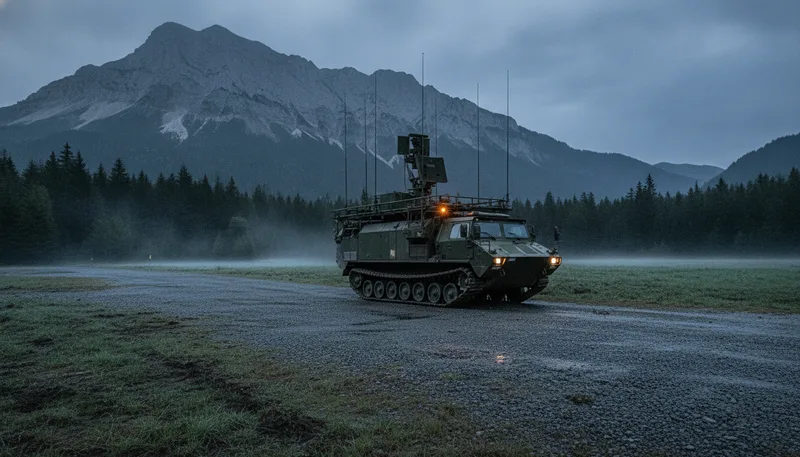
Switzerland joins European Knifefish programme
The Federal Council creates a cooperation framework for electronic attack capabilities – each concrete project still has to be decided separately.
Electronic warfare sounds technical, but it covers an area that has become central for modern armies: the electromagnetic spectrum. This includes radio links, radar signals and other electronic emissions. Anyone able to detect, analyse, protect or jam these signals gains information and can better shield their own assets against hostile interference.
On 14 October, the Federal Council therefore approved Switzerland's participation in the Memorandum of Understanding (MoU) "Knifefish". The MoU is not a purchase contract for a specific system. It is rather a framework for cooperation in the field of electromagnetic warfare capabilities for electronic attack. The Netherlands leads the programme; Germany and Denmark are already taking part, and Sweden intends to join via an amendment agreement.
For the Swiss Armed Forces, the modernisation of electronic warfare assets is the priority. According to the Federal Council, this concerns systems able to detect, influence or jam electromagnetic signals. The aim is therefore broader than a single device: it is about the ability to protect one's own use of the electromagnetic spectrum in operations and to make hostile use more difficult.
What electronic attack means
According to the federal statement, electronic warfare is divided into three areas. Electronic attack makes it harder for hostile forces to use the electromagnetic spectrum. Electronic protection is meant to shield one's own systems from jamming. Electronic support serves to detect and analyse signals. In practice these areas can interact: first signals are detected and analysed, then own systems are protected or hostile emissions are specifically degraded.
Knifefish concentrates on the electronic attack area. That does not automatically entail an immediate operational decision. The agreement now approved primarily organises possible cooperation on procurement and exchange. Which projects Switzerland actually pursues remains open: according to the Federal Council, it can decide anew for each individual project whether to take part.
Why joint procurement is attractive
For highly technical military systems, cooperation is not only a political question. Joint procurements can better align materiel and data. Test equipment and spare parts can under certain circumstances be used jointly. That improves interoperability – the ability of different partners to work together technically and logistically. The Federal Council also cites economies of scale and potentially lower purchase prices as advantages.
The Knifefish accession follows on from the Sawfish programme, which Switzerland joined in November 2025. Sawfish concerns tactical electronic warfare systems. Together, the two steps show that Bern wants to expand European armaments cooperation in this field. This corresponds to the Federal Council's 2025 armaments policy strategy, which provides for targeted cooperation with neighbouring states and other European partners.
Neutrality and room for decision
The Federal Council states that neutrality remains guaranteed by the MoU. The built-in exit is important here: should one of the programme members become involved in an armed conflict, Switzerland can leave the cooperation at any time. The project-by-project decision also protects the room for manoeuvre of the government and parliament in later procurement steps.
The decision is therefore above all a strategic step of opening. It makes it easier for Switzerland to access a European cooperation network for electronic attack capabilities. The statement says nothing, however, about concrete systems, budgets or procurement contracts. These questions would arise separately in the event of participation in individual Knifefish projects.
What will have to become transparent later
The cooperation framework does not yet answer some procurement questions. The Federal Council's statement reveals neither the scope of individual projects nor possible costs, timetables or concrete suppliers. That is not a shortcoming of the MoU but a consequence of its character as a framework agreement. Precisely for that reason it will be crucial to justify later projects in a traceable way: which capability gap is to be closed, how is the protection of one's own systems tested, and which legal limits apply to training and deployment?
The benefit of joint procurement also depends on the actual design. Uniform interfaces or shared spare parts can bring advantages; they do not, however, replace national control over budgets, procurement decisions and rules of engagement. The MoU creates the possibility of cooperation. Whether this produces a concrete security gain for Switzerland must be demonstrated by each individual project.