Section
Economy

SNB communication: Why a speech is not the same as a rate decision
Why do markets react to sentences from central banks? The latest SNB speech shows that communication accompanies monetary policy – but it replaces neither the quarterly decision nor a concrete rate forecast.

No new financial crisis: which warning signs count for Switzerland
A falling euro or a strong dollar can move markets. Whether that turns into a financial crisis depends on resilience, liquidity and contagion effects – and there the picture for Switzerland is more nuanced than the alarmist question suggests.

The franc is more than euro and dollar: Reading the SNB indices
The SNB has updated its exchange rate indices. Why the trade-weighted franc says more about Switzerland than a single euro rate – and where its explanatory power ends.

UBS job cuts: what is officially documented – and what remains open
UBS reports fewer internal and external employees than at the end of 2025. That does not automatically show how many people were dismissed or where jobs disappear. A look at the official figures separates established facts from speculation.

Labour market in September: a monthly fall is no all-clear yet
In September the number of registered unemployed fell by 1,064 people. At the same time, the number of jobseekers rose. The SECO figures therefore show not a simple easing, but a mixed picture.

SDDS Plus: Why an SNB dataset is more than statistics
The IMF's SDDS Plus standard makes Swiss economic and financial data more comparable. It is not a monetary policy signal, but it matters for public scrutiny.

Unemployment insurance 2025: the CHF 249m loss isn't the whole story
Switzerland's unemployment insurance closed 2025 with a loss of CHF 249 million. Decisive are not only more registered unemployed people but also federal payments that no longer apply.

Hormuz: pipelines cannot replace the strait – Switzerland's stakes
Pipelines can carry part of oil exports around the Hormuz bottleneck. For Switzerland, supply remains secure, but fragile.
Switzerland–India: What the TEPA free trade deal must now deliver
One year after the TEPA free trade agreement started, what counts is not the trip to New Delhi but the benefits for Switzerland.

135 million for Ukraine projects: Why Switzerland bets on companies
With state support, Swiss firms are to deliver energy, water and public transport projects in Ukraine. The approvals link reconstruction policy, trade promotion and development cooperation.

High diesel prices: why a fuel rebate won't fix the supply problem
In September, diesel cost clearly more in the Basel border zone than at the start of the year. A fuel rebate could bring short-term relief, but it would solve neither strained transport routes nor the question of targeted social policy.
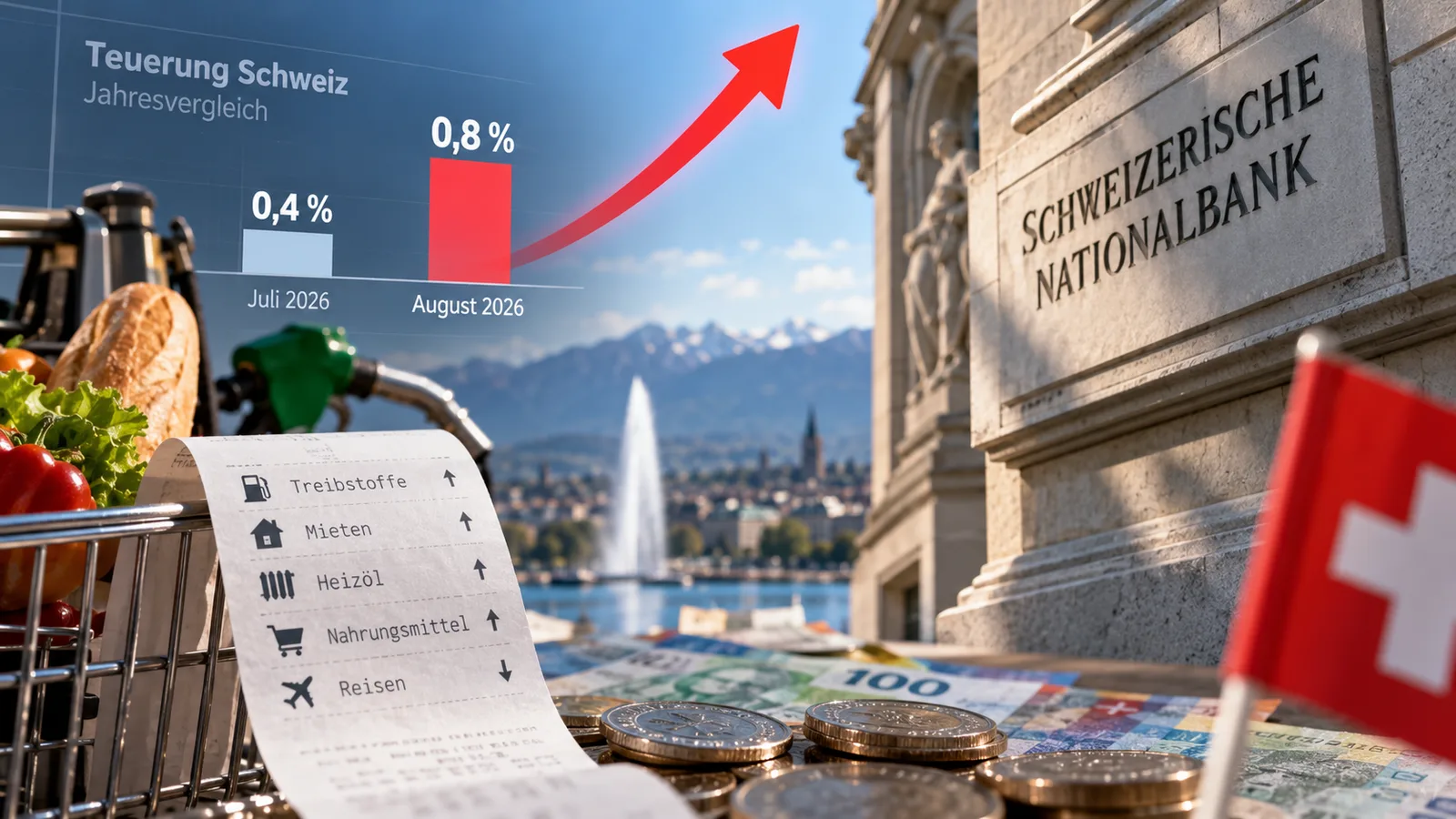
Consumer prices in autumn 2026: what drives the LIK
The national consumer price index measures inflation in Switzerland month by month. How strongly rents, electricity tariffs and imported goods move the basket can be checked only against the original publications of BFS, BFE and SECO.

EFTA-Kosovo Agreement: Market access is no trade boom
The EFTA-Kosovo agreement is now fully in force. Its biggest short-term effect is a more reliable legal framework – not automatically growing trade.

Micasa closes four stores and changes owners
Micasa is getting new owners and closing four shops. A look at the plans of 2025 shows how far the course has shifted – and what remains unresolved today.

Manchester City found guilty: what ruling leaves open
Manchester City has been found guilty in the financial case. But the guilty verdict does not settle the question of consequences.

SNB raises growth outlook, yet industry stays under pressure
The SNB expects growth of 1.5 to 2 percent in 2026. The new confidence does not change the fact that industry and the labour market are sending different signals.

SNB regional contacts: why the Swiss economy shows no single picture
The SNB's latest talks with companies show a Switzerland in which sectors and regions react differently to prices, demand and the exchange rate.

Istanbul overtakes Heathrow: What makes an airport a hub
Istanbul tops the OAG Megahubs ranking for the first time. The position reflects the strength of a finely tuned transfer system. For Switzerland, the question is less about copying it than about the framework conditions for Zurich and Swiss.

WordPress flaw actively exploited: what operators must check
CISA confirms active attacks on a WordPress core flaw. Anyone running an unpatched installation should update – and then check whether files or accounts have already been changed.

Gold Falls Despite Crisis Appeal: How the Dollar and the Fed Drive It
Gold loses more than two percent in a week. How the Fed, the dollar and yields move the price — and why Swiss investors must also watch the franc.

Swiss sanctions: what changes for companies on 1 November
The Federal Council is clarifying the financial rules in four sanctions ordinances. What companies must now note on blocked accounts, reporting duties and humanitarian exemptions.

Xi in Washington: Where China Has Gained Power Since 2015
Xi Jinping is in Washington for a state visit. Since 2015, China has expanded its industrial leverage. Current data nevertheless show a balance of power without a clear winner.

Parmelin touts free trade – where Switzerland stays open and where not
Guy Parmelin warns against new trade barriers at the UN. How consistently does Switzerland apply that standard in its own trade policy?

Global Diesel Squeeze: Why Switzerland May Feel the Price Surge
International diesel prices have risen sharply. What role refineries, Rhine levels, mandatory stockpiles, the franc and levies play for Swiss prices.
What changes in Switzerland on 1 October 2026: five key updates
Five changes take effect in Switzerland on 1 October 2026. JournalPlus explains who is affected, which deadlines apply and when action is actually required.

Why chemicals and pharma distorted Swiss foreign trade in August
Foreign trade statistics show a sharp drop in August. One single segment was decisive: chemicals and pharmaceuticals. Without it, export development stayed positive.

Retirement planning from 50: what can still be corrected
At 50, much of a working life is already written – but the financial starting point for retirement is not yet fixed. AHV gaps, the pension fund, pillar 3a, the mortgage and the desired retirement date now need a first joint calculation.

Cembra moves to Baden: What the relocation means for Zurich
Cembra is planning the move to Baden. The frequently cited figure of 660 refers to employees at the current headquarters, not to announced job cuts.

Migros weighs overhaul of its ten cooperatives: who decides
From ten to three – or even a single cooperative: according to media reports, Migros is examining far-reaching models. Nothing has been decided. What matters is what rights regional cooperatives and their members keep.

Energy crisis as a US advantage? What the data actually show
The US exports more liquefied natural gas while Europe pays higher prices. A data check shows the winners, the costs and the limits of the thesis of an American energy coup.

Food statistics: 54 percent self-sufficiency, 21 sugar cubes
Switzerland covers just over half of its food needs itself. The data check shows big differences between milk, meat and fish – and gaps in the statistics.

EC English closes: What language students need to know now
EC English has ended operations after 35 years, hitting 25 schools in seven countries. Students affected should secure their contracts, payment records and insurance cover – blanket refund guarantees do not exist.

149 days later: why Bern does not adopt EU sanctions by default
149 days passed between the EU decision and its entry into force in Switzerland. The Belarus case shows how political independence leads to rules that differ for a time.

Paramount-Warner settlement: film counts set, diversity unclear
The proposed settlement on the Paramount-Warner merger contains precise film requirements and sanctions. Why production numbers alone do not secure competition.

Macron seeks looser fuel rules – what the EU must examine
Paris asks Brussels for flexibility on fuels and biofuels. Why high prices do not automatically mean a shortage, and what an exemption could cost.

Sunrise reviews 450 jobs – the cuts are not yet decided
Sunrise is examining up to 450 job cuts. Nothing is final yet; the collective agreement gives the consultation and the social plan real weight.

Swiss economic forecast: why 1.7 percent is not yet an all-clear
1.7 instead of 0.9 percent: the federal government has revised its GDP forecast upwards. Why that does not automatically mean a broad upturn, and which factors could tip expectations again.

A free Sunday rests on other people's work
Anyone served or cared for on a Sunday is using someone else's working time. What the law protects – and why a free Monday does not fully replace a Sunday.

US sanctions: Washington's leverage targets Russia's buyers
Washington is stepping up pressure on Moscow and its trading partners. The law could also affect Swiss banks and commodity traders – but its impact depends on enforcement.

Helvetia Baloise expects up to 140 million francs in hail damage
Helvetia Baloise expects hail damage of 120 to 140 million francs after reinsurance. What the figure means – and why cars shape the industry's balance.

Trump threatens EU with new trade barriers over Canada
Trump is pressuring the EU over its Canada plans. What he is threatening, what has already been ordered, and why Swiss suppliers have to follow this conflict.

Culture Grows Broadly – Not in Full-Time Jobs
More cultural businesses, but few additional full-time positions: New BFS data shows an industry that is growing while increasingly fragmenting into micro-enterprises.

Anthropic's AI scenarios meet Swiss labour market data
15 percent growth and mass unemployment: the headline sounds like a prediction. In fact, Anthropic's model shows which assumptions lead to extreme results – and where Switzerland is already measuring change.
Canada Moves Closer to EU, But Its Model Has Limited Fit for Switzerland
Canada deepens its partnership with the EU without being a candidate for accession. For Switzerland, this is politically interesting, but not a replacement for its bilateral agreements.

Mood Improves, But Willingness to Buy Declines
Swiss consumer sentiment improves to –33 points. However, confidence in the future and major purchases are weakening, despite economic growth and low inflation.

Hormuz and Saudi Pipeline Under Pressure: Oil Shock Cost for Switzerland
The Strait of Hormuz is nearly blocked, and Saudi Arabia's main bypass route is temporarily out of action. For Switzerland, this presents an inflation risk, tempered by several factors.

Swiss Medtech Grows, But Domestic Job Creation Stalls
Swiss Medtech firms see revenue growth, but job creation lags. The latest industry data reveals crucial insights into Switzerland's appeal as a business location and the future of domestic employment.

Letters Become a Losing Business – Parcels Drive Postal Market
In 2025, letter revenues no longer covered costs for the first time. Simultaneously, parcels and import shipments are growing. This challenges the financing of comprehensive basic postal services.